Westeros Sigil
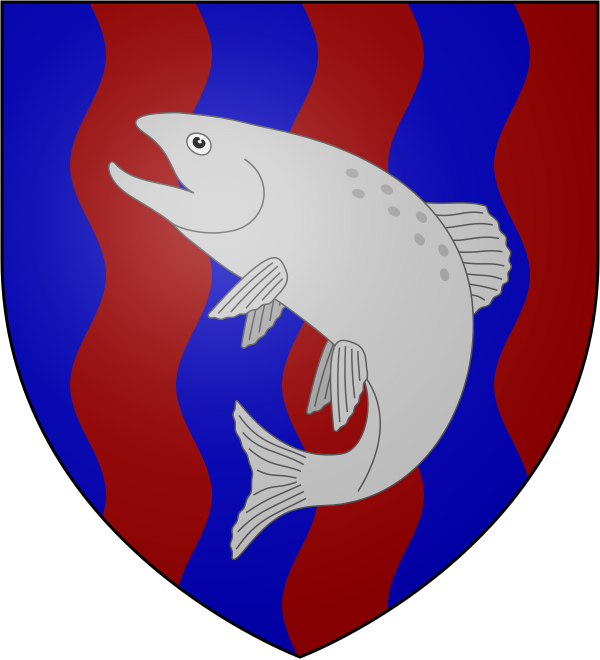
Paly wavy azure and gules, a trout embowed argent
Words Family, Duty, Honor
After three houses whose arms break the rules of heraldry, here is the one that keeps every one of them. No invented tincture, no impossible charge, no contrast to argue about. A herald could grant these tomorrow.
Lords Paramount of the Trident, seated at Riverrun where the Tumblestone meets the Red Fork. And the only great house of the realm that never ruled as kings — their eminence is a Targaryen grant, not an ancient crown.
Click on a country to learn more
A silver trout leaping, on a striped field of blue and mud red.
Rendered in classical terms: Paly wavy azure and gules, a trout embowed argent.
Like the Boltons and unlike the Martells, the Tullys owe their arms to the text rather than to an appendix. The sigil and the words are both given in A Game of Thrones, chapter 18 (Catelyn IV) — and the character who carries them through the series is the one who was born to them.
Paly means the field is divided into vertical stripes. Not barry, which would be horizontal: the Tully stripes run up and down the shield, which is how a river is drawn when it is meant to be seen flowing towards you rather than across.
Embowed is the heraldic posture of a fish bent into an arc — exactly the shape a trout makes when it leaves the water. It is an ordinary term. A herald asked to draw a leaping trout would reach for it without thinking.
This atlas has spent three houses on arms that European heraldry would have refused, corrected or never imagined. The Tullys are the control case.
Barry wavy and paly wavy of argent and azure are the standard European way of representing water — a sea, a ford, a river — and they turn up on the arms of river towns and port cities across the continent. The Tully field is not a stylised invention. It is the conventional heraldic river, with one of its two tinctures changed.
Blue and red together might look like a breach of the rule of tincture, the rule that keeps colour off colour. It is not, and the distinction is exact: the rule governs one thing laid on another — a charge on a field, a field on a field. A field simply divided between two colours places them side by side, not one over the other, and heralds have always treated that as permitted.
So the Tully field passes where the Martell field does not. Red on orange is a red sun sitting on an orange ground; blue beside red is two stripes meeting along an edge. And the trout is argent — metal on colour, the correct way round.
Set the four side by side and the Tullys are the only house whose shield needs no excuse.
A reading, offered as a reading: nothing in the books says this in so many words.
Riverrun stands at a confluence. The Tumblestone borders it to the north, the Red Fork to the south, and a man-made ditch closes the third side, so that opening the sluice gates turns the castle into an island. The seat is defined by two rivers meeting.
The arms are a field of wavy stripes in two colours — blue, and a red the text calls mud red. One of the two rivers is called the Red Fork.
The books keep the colour close to the water without ever joining the two:
Read that way, the shield is not decorated with water: it is a map of the spot the castle sits on, which is what a great many real European civic arms are.
Arms that pun on the bearer’s name are canting arms, the oldest game in European heraldry. Fish are one of its favourite instruments: the Lucy family of England bore three luces hauriant — a luce being a pike — and the joke is simply Lucy / luce.
The Tully trout does not pun on Tully. It puns on Riverrun, on the riverlands, on the Trident: the house is named for nothing in particular, but its seat, its region and its overlordship are all water, and the shield says water three times over — in the stripes, in their waviness, and in the fish.
And the charge does not stay on the shield. The Tully guardsmen wear fish-crest helms. The pillars of Lord Hoster’s canopied bed are carved as leaping trout. This is how arms behave in the real world — they leave the shield and colonise the household, the plate, the furniture, the livery — and it is something Westerosi heraldry only rarely bothers to show.
Every other great house in this atlas descends from a crown. The Starks were Kings of Winter, the Lannisters Kings of the Rock, the Martells Princes of Dorne, the Boltons Red Kings at the Dreadfort. The Tullys were none of these. They were one riverlord among many, in a region ruled for generations from outside it.
What made them a great house was a decision. When Harren the Black summoned the riverlords to defend Harrenhal against Aegon Targaryen, Lord Edmyn Tully was the first riverlord to declare for the invader, and rode out with his knights and archers to join him. The other lords of the Trident followed. Harren and his line burned in their own castle, and Aegon raised Edmyn to Lord Paramount of the Trident, requiring the other riverlords to swear to him.
Edmyn went on to serve as Hand of the King from 7 AC, and resigned in 9 AC when his wife died in childbirth, judging that his children had more need of him than the realm did. The words on the shield were not yet the words on the shield, but the order of them was already being observed.
In Europe, a family raised this way marks the promotion on its arms. That is what an augmentation of honour is: a canton, a chief, a charge added by the sovereign to record a service done to the crown, and thereafter borne for ever. Families have carried a king’s own device in one quarter for centuries on the strength of a single afternoon.
The Tully shield records nothing. No canton, no chief, no dragon, no mark of the day the house changed rank. The arms of the greatest riverlords in Westeros are exactly the arms of the minor riverlords they used to be.
Family, Duty, Honor.
Unlike the Bolton words, these are in the books — given alongside the sigil in A Game of Thrones, chapter 18.
They are also the only house words in this atlas that are not a statement at all. Winter Is Coming is a warning. Unbowed, Unbent, Unbroken is a denial. Our Blades Are Sharp is a remark about equipment. Family, Duty, Honor is a list in order of precedence — three nouns, no verb, and the whole meaning carried by the sequence.
Which is to say it is not a boast but an instruction, and specifically an instruction for the case where the three conflict. Put family first. Then what you owe. Then what people will say of you.
It is a strange thing to write on a shield, because it concedes in advance that the three will come apart. No other house in the setting admits as much on its own arms.
A silver trout leaping on a striped field of blue and mud red — in classical terms, Paly wavy azure and gules, a trout embowed argent. The words are Family, Duty, Honor and the seat is Riverrun. Both are given in A Game of Thrones, chapter 18.
No. The rule governs one thing laid on another, not a field divided between two colours placed side by side, which heralds have always allowed. The trout itself is argent, a metal on a colour, which is the correct way round. These are the most regular arms of any great house in Westeros.
The books do not say. One reading is that it records the confluence the castle stands on: Riverrun sits between the Tumblestone and the Red Fork, and the Red Fork is named for its colour. The castle’s own walls are red sandstone, and Tully dead are burned on boats set adrift on the Red Fork.
Not on the name, which is what canting usually means. The trout puns on the place instead — Riverrun, the riverlands, the Trident. Compare the English Lucy family, whose three luces, or pike, pun directly on the surname.
No, and they are the only great house in that position. They were one riverlord among many until Lord Edmyn Tully became the first to declare for Aegon the Conqueror against Harren the Black, and was raised to Lord Paramount of the Trident after Harrenhal burned. Their shield records none of it.
A note on method. The heraldic statements above are taken from the books’ own wording where the text gives it, and marked as a reading where that is what they are — the two rivers in particular. The comparisons with European practice — paly wavy, embowed, the rule of tincture, canting arms, augmentations of honour — are statements about real heraldry, not about the books. The television adaptation is not used: it redesigned several sigils, and on a heraldry site the two cannot be mixed.
Last reviewed by the Emblema Mundi editorial team on 27 September 2026.