Westeros Sigil
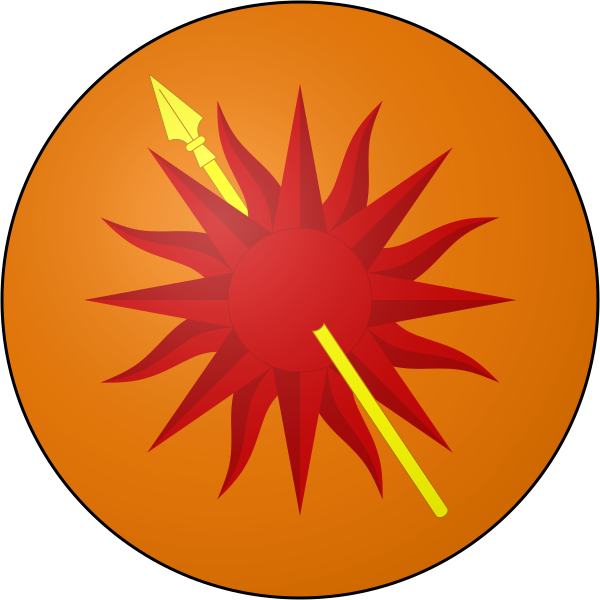
Tenné, a sun-in-splendour gules transfixed by a spear or
Words Unbowed, Unbent, Unbroken
The only arms in Westeros that record a marriage inside a single charge. The spear came from the husband, the sun from the wife — and instead of setting the two side by side the way European heralds would, the Martells ran one through the other.
Princes rather than kings, seated at Sunspear — a castle named after the shield, and not the other way round. Dorne is the kingdom Aegon’s dragons never took.
Click on a country to learn more
A red sun pierced by a golden spear, on orange.
Rendered in classical terms: Tenné, a sun-in-splendour gules transfixed by a spear or.
The wording comes from the appendix to A Clash of Kings, where the houses of the realm are listed with their seats, their words and their arms. As with every Westerosi house, there is no register behind it and no granting authority: what the appendix says a house bears is what it bears.
The interesting word is pierced. Most arms set their charges beside one another, or one above another, or one on a field. Here the spear is driven through the sun, so that neither can be described without the other. European blazon does have the vocabulary — transfixed, pierced, debruised — but it uses it sparingly, and almost never to join the emblems of two families.
The sun itself is a perfectly ordinary European charge. A sun in splendour — a sun with a face and alternating straight and wavy rays — is the badge Edward IV took after the parhelion at Mortimer’s Cross in 1461. Shakespeare opens Richard III on it — “this sun of York” — and it is one of the few charges that passed from a real royal badge into the common repertoire.
Orange is not one of the ordinary tinctures. European heraldry works from a closed list — two metals, or and argent, and the colours gules, azure, sable, vert, purpure — and orange is not on it.
But unlike the grey of the Stark direwolf, orange at least has a name: tenné. It belongs to a small third group, the stains — tenné, sanguine and murrey — which the armorials record and then barely use. Some older heraldic writers claimed the stains marked arms with dishonour; that theory is an invention of the writers rather than a practice ever found in real grants, and it is best set aside.
The rule of tincture is not decoration. Arms exist to be told apart at a distance, so metal does not sit on metal and colour does not sit on colour. A red sun on an orange field is colour on colour, and worse, two colours from the same corner of the spectrum — legible on a page, a blur on a field.
What saves it is the spear. The spear is or, a metal, laid straight across the sun from end to end, and it puts a bright line of contrast through the exact centre of the device. Where the Stark arms have nothing to rescue them — grey on white, and no third element — the Martell arms carry their own correction. It is an accident of the design rather than an application of the rule, but the result reads.
The Martells are one of the very few houses in the setting whose earlier arms are on record. Before the Rhoynar came, they bore the spear alone: Tenné, a spear or. They were minor Dornish lords then, seated at the Sandship, vassals in turn of the Jordaynes, the Allyrions and the Yronwoods.
The sun was not theirs. It was the emblem of Nymeria and the Rhoynar she brought across the sea. When Nymeria married Lord Mors Martell of the Sandship, around 700 years before Aegon’s Conquest, the two devices were combined into the arms the house has borne ever since.
Real heraldry has a procedure for precisely this situation, and it is not what the Martells did.
A husband marshals his wife’s arms by impalement: the shield is split down the middle, his coat on the dexter half, hers on the sinister. Or the two are quartered, each keeping a quarter of its own. Both methods share a principle — the coats are juxtaposed. Each stays whole, each stays readable, and a later generation can quietly drop the one it no longer needs.
The Martells did the opposite. They fused the two emblems into a single charge that cannot be taken apart again. Remove the spear and the sun is Rhoynish; remove the sun and the spear is Andal; leave them as they are and the shield is neither, and both. For a marriage that turned two peoples into one kingdom, it is the better emblem. It is also, strictly, the worse heraldry: a herald would object that the arms of two houses have been destroyed to make a third.
The shield is only half of it. The house’s full style is House Nymeros Martell of Sunspear, and Nymeros is generally glossed as “of the line of Nymeria”. One caution, given plainly: that gloss comes from a statement by the author outside the novels — an answer given in 2001 — not from the books themselves. The name is in the books; the translation is not.
What the books do give is the practice around it. Nymeria named her husband Prince of Dorne rather than King. Their lands and title passed to their eldest child, a daughter — and kept doing so, Dornish law holding to the eldest child regardless of sex, where the rest of Westeros puts sons first. Nymeria herself ruled for more than two decades after Mors’s death, and remarried without the succession moving to her son.
In European practice, arms descend in the male line. When a man marries an heiress, her arms enter his family on an escutcheon of pretence, a small shield at the centre of his own, and pass to their children as a quartering. Within a generation or two the wife’s coat is one compartment among several, and within a few more it is often dropped.
The Rhoynar reversed the direction, and then made it permanent by putting it somewhere heraldry cannot erode: the name itself. Seven hundred years on, every Martell still carries the word that says which of their two founders the line is counted from — and it is the wife.
Castles usually give their names to arms, or at least to houses: Winterfell to the Starks of Winterfell, Casterly Rock to the Lannisters of Casterly Rock. Sunspear runs the other way. The reference works state it flatly: the castle is named for the sigil.
The old keep was the Sandship, a squat dun-coloured building shaped like a dromond. After the marriage, towers in the Rhoynish manner rose around it, and the whole complex took the name of the new arms — sun and spear.
Two of those towers are the first things a visitor sees, whether arriving by land or by sea: the tall, slender Spear Tower, and the great domed Tower of the Sun. The charges of the shield, standing apart as architecture.
And inside the Tower of the Sun the separation is completed. The Prince of Dorne does not sit on one high seat but on two twin seats — one with the Martell spear inlaid in gold upon its back, the other bearing the blazing Rhoynish sun.
Follow the sequence. Two houses bring two emblems; the emblems are fused into one charge that cannot be divided; the charge names a castle; the castle splits the charge back into two towers; and at the heart of the second tower the two halves are set side by side again as two thrones. Nowhere else in the setting does a coat of arms work that hard.
Unbowed, Unbent, Unbroken.
In European heraldry a motto is an accessory: added, altered, dropped, and no part of the grant. In Westeros the words travel with the shield and are named alongside it, so a house without words is a house half-described.
Look at the grammar. Three past participles, each negated, with no verb, no subject and no object. Most house words claim something — Hear Me Roar, Fire and Blood, Growing Strong. These claim nothing. They only deny that three things were done to the house, which means the words presuppose someone trying.
They are also the rare house words that a reader can check.
Queen Rhaenys Targaryen rode to Sunspear during the Conquest and was told by the aged Princess Meria Martell to leave; she left, and Dorne was the one kingdom of the seven that Aegon did not take. The First Dornish War, launched in 4 AC, cost the Targaryens a queen and a dragon at the Hellholt and ended in 13 AC by treaty rather than surrender.
One correction that is often needed: Dorne was not permanently unconquered. King Daeron I took it in 157–161 AC — the Submission of Sunspear — and lost it to rebellion within a few years, Daeron himself dying under a peace banner. Dorne finally entered the realm in 187 AC, by the marriage of Prince Maron Martell to Princess Daenerys Targaryen. Not by fire: by a wedding, which is how this house had settled its first great question as well.
A red sun pierced by a golden spear, on an orange field — in classical terms, Tenné, a sun-in-splendour gules transfixed by a spear or. The words are Unbowed, Unbent, Unbroken and the seat is Sunspear. The arms and the words are given in the appendix to A Clash of Kings.
Because the two emblems belonged to two different houses. The Martells of old bore a golden spear on orange; the sun was the device of Nymeria and the Rhoynar. When Nymeria married Lord Mors Martell, the two were combined into one charge rather than set side by side, as a European herald would have done by impaling or quartering them.
Yes, and more easily than most Westerosi arms. Orange has a heraldic name, tenné, though it is a stain rather than an ordinary tincture and armorials rarely use it. The red sun on an orange field does break the rule of contrast, but the golden spear laid across the sun restores a line of metal through the centre of the device.
It is generally glossed as “of the line of Nymeria”, marking descent from the Rhoynish princess who married Mors Martell. The gloss comes from an answer the author gave outside the novels, in 2001, rather than from the books. The books do show the practice behind it: Dornish titles pass to the eldest child regardless of sex.
Aegon the Conqueror never took it, and the First Dornish War ended by treaty in 13 AC. But King Daeron I did conquer Dorne in 157–161 AC, only to lose it to rebellion within a few years. Dorne joined the realm for good in 187 AC through the marriage of Prince Maron Martell and Princess Daenerys Targaryen.
A note on method. The heraldic statements above are taken from the books’ own wording where the text gives it, and marked as a reading or as an out-of-book statement where that is what they are. The comparisons with European practice — impalement, quartering, the escutcheon of pretence, the rule of tincture, the stains — are statements about real heraldry, not about the books. The television adaptation is not used: it redesigned several sigils, and on a heraldry site the two cannot be mixed.
Last reviewed by the Emblema Mundi editorial team on 28 September 2026.