Westeros Sigil
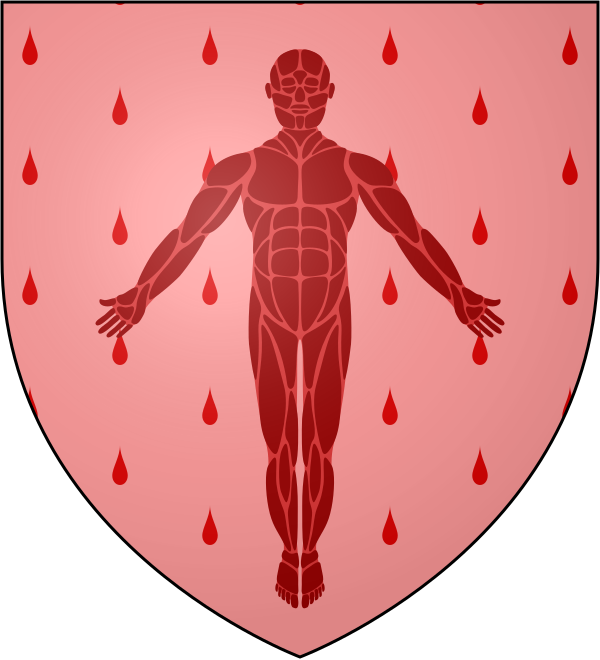
Carnation goutty de sang, a flayed man gules
Words Our Blades Are Sharp
Here is the paradox of Westerosi heraldry in one shield: the arms that look least like heraldry are the ones that blazon best. Every term needed to describe them is real, and was in ordinary use long before Martin.
An ancient house of the North, once Red Kings at the Dreadfort. The charge records a practice the Boltons were made to renounce when they bent the knee to Winterfell — and kept on their shield anyway.
Click on a country to learn more
A red flayed man, on pale pink spotted with red blood drops.
Rendered in classical terms: Carnation goutty de sang, a flayed man gules.
A note on spelling: the reference compilations print this as Carnation gouttée-de-sang, in the French manner. English armorials write the same term goutty or gutty, without accent, and that is the form used throughout this page.
Unlike several famous Westerosi houses, the Boltons do not owe their arms to an appendix. The sigil is described inside the novels themselves and repeatedly — from A Game of Thrones, chapter 53 (Bran VI) onward, and again in A Clash of Kings and A Storm of Swords, seen each time by a different pair of eyes.
That matters for a heraldry site. A device that several characters look at, in several books, is a device whose details the author had to keep consistent — which is how arms behave in the real world, and how invented arms usually do not.
Read the classical form again, one word at a time. Every term in it is real, and none of it was coined for these books.
Carnation is the heraldic word for flesh colour. Heralds needed it because arms are full of human limbs — an arm issuing from a cloud, a hand, a head — and those are tinctured carnation when they are to be drawn as flesh rather than in a colour. It is a convention rather than a tincture proper, but it is centuries old and perfectly ordinary.
A field strewn with drops is goutté, or goutty in English practice, and the drops are named by what they are made of: goutty d’or for gold, goutty d’eau for water, goutty de poix for pitch, goutty de larmes for tears — and goutty de sang for blood. The term existed for centuries as a decorative powdering, most often on a bishop’s or a martyr’s arms.
The Boltons use it literally. Where a real coat is strewn with drops of blood as an emblem of martyrdom, theirs is strewn with drops of blood because something has been bleeding on it.
And here is the point worth carrying away. The Stark arms look like heraldry and can barely be blazoned — grey is not a tincture, and grey on white breaks the rule of contrast, as set out on the Stark page. The Martell arms need tenné, a stain the armorials record and hardly use.
The Bolton arms look like nothing a herald would accept — and blazon almost perfectly. Carnation, goutty de sang, a charge gules: a herald of any century could write that sentence without inventing a word. The most transgressive shield in the setting is the one that submits most completely to the grammar.
A reading, offered as a reading. If the field is carnation — flesh — and it is bleeding, then the shield is not a background on which a flayed man is placed. The shield is a piece of skin, and the flayed man is on it. The device contains itself twice over.
Nothing in the books states this in so many words. But the books do keep tying Bolton pink to actual skin, and they do it too often to be accidental:
A tent of skins is pink. Wax is pink. Ink is blood. The colour of the arms is not chosen for its prettiness; it is the colour of the thing the house is known for. Few arms in this atlas, real or invented, name their own material so exactly.
Human figures are not foreign to European arms. A savage or wild man, a maiden, a king in his chair, a Moor’s head, an arm in armour — the repertoire holds them all, and there are hundreds of examples.
What it does not hold is a body without its skin. The nearest thing European art has is not heraldic at all: the martyrdom of Saint Bartholomew, flayed alive, whose attribute is the flaying knife and who is shown in some works holding his own skin. He is the patron of tanners and leatherworkers, and the knife turns up on their guild arms — but the flayed body stays in the altarpiece and never reaches the shield.
The strangest thing about the charge is its legal position in the story. The Boltons flayed their enemies for as long as they were Red Kings. When they finally bent the knee to Winterfell, roughly a thousand years before the novels, they agreed to give the practice up.
They did not give up the shield. The arms go on showing, in the plainest possible terms, the one thing their overlords had forbidden. In European practice arms are a claim to a right — to a name, a fief, a descent. These are a claim to a habit, kept flying after the habit was outlawed, which is close to an admission carried in public for a thousand years.
Whether the Boltons ever really stopped is left for the reader to decide. The room in the Dreadfort is a rumour in the books, not a fact.
Our Blades Are Sharp.
One caution first, given plainly. Unlike Winter Is Coming or Unbowed, Unbent, Unbroken, these words are not spoken in the novels. They come from a statement by the author outside the books, recorded by the reference compilations. They are house words in the same sense as the others; they are not a quotation from the text, and this atlas does not pretend otherwise.
Taken on their own terms they are the bluntest words of any great northern house. Hear Me Roar is a boast. Winter Is Coming is a warning. Our Blades Are Sharp is neither: it is a statement about equipment. The house that flays announces that its knives are in good order.
The sentence that actually earns the shield is spoken of Roose Bolton, reported by the servant called Reek in A Clash of Kings:
A naked man has few secrets, but a flayed man has none.
Read it next to the arms and the device stops being decoration. A coat of arms exists to declare something publicly and without ambiguity. Roose’s line describes the same operation performed on a person. The shield is not an emblem of the family method; it is the family method, drawn.
A red flayed man on a pale pink field strewn with drops of blood — in classical terms, Carnation goutty de sang, a flayed man gules. The seat is the Dreadfort. The sigil is described in the novels themselves, from A Game of Thrones, chapter 53, onward.
Better than most arms in Westeros. Carnation is the standard heraldic word for flesh colour, and goutty de sang, a field strewn with drops of blood, is an ordinary powdering that European heralds used for centuries. Only the charge itself has no real precedent.
Because the field is flesh. That is what carnation means, and the books keep attaching the colour to actual skin: the skins said to hang at the Dreadfort, the Pink Pavilion that Belthasar Bolton is recorded as having made from the flayed skins of a hundred Sistermen, and the pink wax the house seals its letters with.
They agreed to, about a thousand years before the novels, when they bent the knee to the Starks of Winterfell. They kept the flayed man on their shield regardless. Whether they truly stopped is left open: the room of hanging skins at the Dreadfort is reported in the books as a rumour.
A note on method. The heraldic statements above are taken from the books’ own wording where the text gives it, and marked as a reading or as an out-of-book statement where that is what they are — the house words in particular. The comparisons with European practice — carnation, goutty de sang, marks of difference, the treatment of legitimised bastards — are statements about real heraldry, not about the books. The television adaptation is not used: it redesigned several sigils, and on a heraldry site the two cannot be mixed.
Last reviewed by the Emblema Mundi editorial team on 28 September 2026.