Westeros Sigil
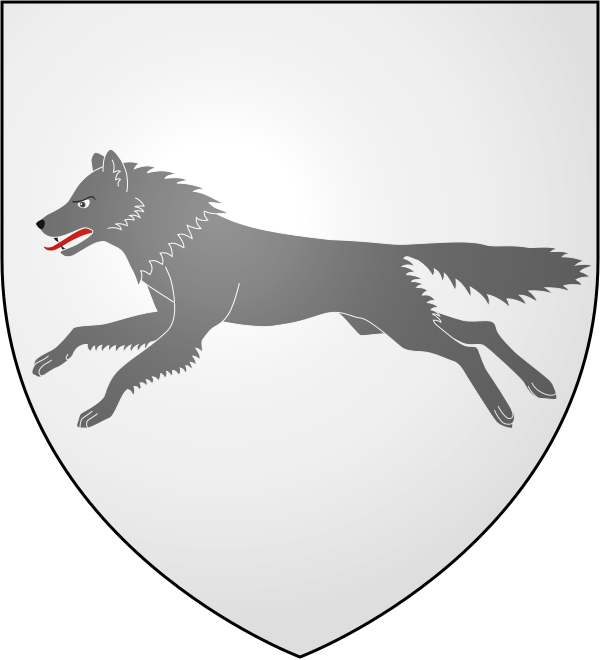
Argent, a direwolf courant cendrée
Words Winter Is Coming
The best-known arms in modern fantasy are also among the hardest to render. Grey on white is a pairing the rule of tincture exists to prevent, and the grey itself is a colour the armorials barely admit.
Lords of the North and Kings of Winter for thousands of years, the Starks ruled from Winterfell. Their sigil and their words are both fixed in the first chapter of the first book.
Click on a country to learn more
A running grey direwolf, on an ice-white field.
Rendered in classical terms: Argent, a direwolf courant cendrée.
The sigil and the words are both established in A Game of Thrones, chapter 1 — Bran I. Not in an appendix, not in a later volume: in the opening chapter of the series. Few houses in the setting are fixed so early or so precisely.
Note the posture. The wolf is courant — running, not statant or rampant. It is a detail most renderings keep and most descriptions drop, and it matters: a running beast is a charge in motion, unusual in a repertoire that prefers its animals upright and still.
The charge is unusual among Westerosi arms for a reason that is easy to miss: the direwolf is not an invented beast. The word sits one space away from dire wolf, the common name of Canis dirus, a genuine prehistoric wolf, heavier and larger than the modern animal.
Most of the striking charges in this atlas — the kraken of the Greyjoys, the flayed man of the Boltons, the lizard-lion of the Reeds, the merman of the Manderlys — are fabulous or invented. The Stark wolf is the opposite: a beast that actually walked, scaled up rather than dreamt.
These arms can be blazoned — but look at what it costs.
European heraldry works from a short, closed list: two metals, or and argent, and a handful of colours — gules, azure, sable, vert, purpure. Grey is not among them. To blazon the Stark wolf at all you must reach for cendrée, ash-grey, one of the rare tinctures that armorials acknowledge but almost never use.
So the arms are not unblazonable. They are blazonable only by going outside the ordinary repertoire for their single charge — which is itself a statement about how far Westeros sits from the tradition it borrows from.
The second problem does not go away. The rule of tincture — metal never on metal, colour never on colour — is not a matter of taste. Arms exist to be recognised across a field, and the rule is the engineering that makes that possible.
Cendrée on argent is grey on white. Two near-identical values, one laid on the other: legible at arm’s length, lost at fifty paces. It is close to the worst case the rule was written to prevent.
There is an irony worth stating plainly. A device that fails the test of recognition at distance has become one of the most instantly recognised in the world — because it is read on a page and a screen, never across a battlefield.
European arms are pictures. The lion on a shield is not a lion anybody owns; nobody keeps it, feeds it or is followed about by it. The charge is a sign, and the distance between the sign and the animal is the whole point.
The Starks are the one house in this atlas where that distance closes.
In the first chapter of the first book, Robb Stark finds a dead female direwolf on the road, with a litter of six pups still alive beside her. Lord Eddard Stark lets his children keep them — one each, which is exactly the number required.
So the house whose sigil is a direwolf acquires direwolves. The animals are named, they grow to the size of ponies, they frighten horses that were trained not to be frightened, and they follow the children of the house for the rest of the series. The charge steps off the shield and walks beside the bearer.
Six pups, and the sixth is the odd one: an albino, white with red eyes, found apart from the rest of the litter. It goes to Jon Snow.
That is the same logic the North applies to names, set out further down this page. The trueborn children get the beast of the house; the bastard gets the beast of the house in a form that cannot be mistaken for the others. It is a mark of difference, and it is alive.
The dead direwolf did not die of nothing. When the men in the party examine her, they find a large piece of shattered antler lodged in her throat. They read it as a bad omen, and say so on the spot.
Read it as heraldry instead and it becomes something sharper. An antler belongs to a stag, and a crowned stag is the charge of House Baratheon, the house that has just taken the throne and is riding north to collect Eddard Stark.
The series opens by putting two coats of arms in the same sentence and having one kill the other. A wolf, dead, with a stag’s weapon in her throat — and her young surviving her. It is done before either device has been explained to the reader, and before either house has done anything.
The image is not incidental. It is on record that this scene — young people finding a dead direwolf with a stag’s antler in its throat — was among the first things the author had of this story, before the plot around it existed. The arms came first, and the story was built to reach them.
Beneath Winterfell lie the crypts, and in them the Starks keep a practice that a medieval mason would have recognised instantly.
Statues are carved for the Kings in the North and the Lords of Winterfell. Each is shown with a great stone direwolf curled at his feet, and an iron longsword laid across his lap — the sword, by tradition, to keep vengeful spirits inside the crypt.
Put a photograph of a European tomb effigy next to that description. From the twelfth century onwards, the recumbent figure on a tomb is carved with a beast at the feet: a lion under a knight, very often, or a dog under a lady — and a sword along the body. The beast is a real convention with real meaning, not decoration.
What the Starks add is that the beast at the feet is their own charge. In Europe the lion under a knight’s heels is usually a generic emblem of courage and has nothing to do with the arms above it. At Winterfell the animal on the tomb, the animal on the banner and the animal in the yard are the same animal. The arms are repeated on every generation, underground, where no herald will ever see them.
The same austerity runs through the one royal object the house owned. The crown of the Kings of Winter was not gold. It was an open circlet of hammered bronze, incised with the runes of the First Men, surmounted by nine black iron spikes wrought in the shape of longswords.
Bronze and iron, runes and swords — the same materials as the tombs, made by the same logic. King Torrhen Stark laid that crown at Aegon the Conqueror’s feet rather than burn his kingdom for it, and what became of it afterwards is not recorded.
Winter Is Coming.
The reference works make a point about these words that is worth repeating: they are one of only a few house mottoes in Westeros that are a warning rather than a boast.
Set them beside the others. Hear Me Roar, Fire and Blood, Unbowed, Unbent, Unbroken, Ours Is the Fury — threats, claims, declarations of strength. Winter Is Coming is none of those. It is addressed to the house itself as much as to anyone else, and what it promises is not victory but hardship.
In European heraldry a motto is an accessory: added, changed, dropped at will, and not part of the grant. In Westeros the opposite holds — the words travel with the shield.
The proof is elsewhere in the setting. When Orys Baratheon took the arms of the extinct Durrandons, he took the blazon and the words together: the two were a single inheritance, not a shield with a slogan attached.
Westeros is closest to real heraldic law at exactly one point: illegitimate children may not bear the arms unaltered.
But the system that actually operates in the books is applied to the name, not the shield. A bastard born in the North is a Snow, as one born in the Vale is a Stone, in the Stormlands a Storm, in Dorne a Sand, in the Reach a Flowers, in the Iron Islands a Pyke.
Functionally this is a mark of difference: a sign of illegitimacy carried for life, declared at first introduction, and regional rather than personal — simply attached to what a man is called rather than to what he bears. Whether that is gentler than a bend sinister, or crueller, the books leave open.
A running grey direwolf on an ice-white field — in classical terms, Argent, a direwolf courant cendrée. The words are Winter Is Coming and the seat is Winterfell. Both sigil and words are given in A Game of Thrones, chapter 1, Bran I.
Yes, but only by using cendrée, an ash-grey that armorials acknowledge without really using. And even then the result breaks the rule of contrast: grey on white is close to the worst case the rule exists to prevent.
No. The name is one space from dire wolf, the common name of Canis dirus, a real prehistoric wolf larger than the modern species. Unlike the kraken or the flayed man, the Stark charge is a real beast, enlarged.
Six. Robb Stark finds a dead female direwolf with a litter of six pups in the first chapter of A Game of Thrones, and Eddard Stark lets the children keep one each. The sixth, an albino found apart from the rest, goes to Jon Snow.
A stag. The men find a large piece of shattered antler lodged in her throat and read it as an omen. Since a crowned stag is the charge of House Baratheon, the scene sets two coats of arms against each other before either has been explained.
Snow, like every acknowledged bastard of the North. The regional bastard surnames — Snow, Stone, Storm, Sand, Flowers, Pyke — work as a mark of difference applied to the name instead of the shield.
A note on method. Where the books give the wording, it is quoted; where a source offers an interpretation, it is marked as one. The comparisons with European practice — the tinctures, the rule of contrast, marks of difference, the beast at the feet of a tomb effigy — are statements about real heraldry, not about the books. The television adaptation is not used as a source: it redesigned several sigils, and on a heraldry site the two cannot be mixed.
Last reviewed by the Emblema Mundi editorial team on 28 September 2026.