Westeros Sigil
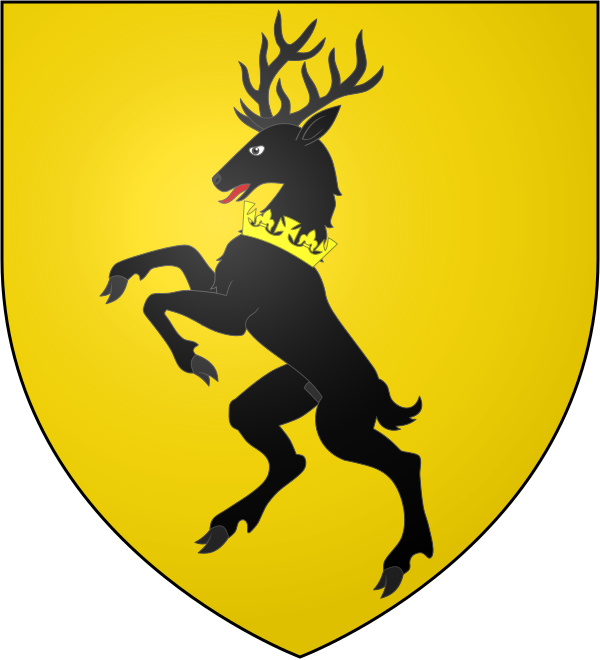
Or, a stag crowned sable
Words Ours is the Fury
The youngest of the great houses, and the only one whose arms are inherited rather than invented. Orys Baratheon took the shield and the words of the kings he destroyed, whole, and changed nothing.
Lords of Storm's End and Lords Paramount of the Stormlands. Three centuries later the house split into three branches, and between them they produced the only correct marshalling in Westeros — and the strangest augmentation.
Click on a country to learn more
A crowned black stag, on a golden field.
Rendered in classical terms: Or, a stag crowned sable.
The sigil is given in A Game of Thrones, chapter 4 (Eddard I), and the words in the appendix to the same volume.
Sable on or: a colour on a metal, the right way round, with maximum contrast. Nothing here would trouble a herald.
The detail worth stopping on is the crown. A crowned beast is not decoration in European blazon — it is a specific and meaningful attribute, and it is not handed out freely. A lion or a stag crowned is a beast marked as royal, and heralds were careful with it. The stag of Storm’s End has worn that crown since long before any Baratheon bore it, because it did not start as a Baratheon stag at all.
Every other great house in this atlas invented its device, or is said to have carried it out of legend. The Baratheons are the single exception, and they are also the youngest great house in Westeros: founded in 2 BC, within living memory of the Conquest.
Storm’s End was the seat of the Storm Kings, a line reaching back to the Age of Heroes. Their arms were Or, a stag crowned sable. Their words were Ours is the Fury. Both are exactly what the Baratheons bear today, because the Baratheons took them.
Orys Baratheon was one of Aegon the Conqueror’s generals, his closest companion, and — by rumour that the chronicles do not settle — his bastard half-brother. He defeated and killed the last Storm King, took that king’s only daughter, Argella, to wife, and became the first Lord of Storm’s End. And he took the sigil and the words of her house for his own.
What makes this sharp is that the same conquest produced the opposite decision a few hundred miles west. The Tyrells took Highgarden from the extinct kings of the Reach in the same war, from the same Aegon, and did not take their arms. They kept the rose they had borne as stewards, and the green hand of the Reach simply stopped.
Two houses, one conquest, two answers to the same question: when you take a dead king’s seat, do you take his shield? Westeros gives both answers and never comments on either.
Orys did not invent his solution. He arrived at a situation European heraldry has a whole machinery for — and then ignored the machinery.
A woman with no surviving brothers is an heraldic heiress. Her arms do not die with her father: her husband bears them on a small shield at the centre of his own, called an escutcheon of pretence, and their children quarter the two coats, so that both survive, side by side, for ever. It is the single most common way a European shield acquires a second quarter.
Argella Durrandon was exactly that heiress. Orys married her, and then did none of it. He assumed her arms entire and dropped his own. No escutcheon, no quartering, no mark of his own line anywhere on the shield. A man founds a house and gives it someone else’s device, unaltered.
Set it beside what happened at Casterly Rock, where a king died leaving only a daughter and her Andal husband took the Lannister name and kept the arms that came with it.
Both are ways of stopping a line from disappearing when it runs to daughters, and European practice knows both — the second is what a name and arms clause was written to compel. Westeros performs each of them once, at opposite ends of the continent, and treats neither as remarkable.
After Robert’s Rebellion the house split in three. The eldest brother took the throne and founded the royal line at King’s Landing, and that branch did something no other house in the setting manages.
Its arms are Per pale gules and or, a lion rampant of the second, a stag sable — the shield split down the middle, the Lannister lion on one half, the Baratheon stag on the other.
That is impalement, and it is textbook. A husband impales his wife’s arms with his own: his coat on the dexter half, hers on the sinister, one shield, both families legible. It is what European heralds have done for a married man’s arms for seven hundred years, and it is the correct answer to a question no other Westerosi house appears to have asked.
Heraldry is a language for stating claims, which means it can be used to state false ones. The royal shield asserts a marriage between two great houses, and asserts that the heirs of that marriage carry both bloods.
Readers of the books know what the shield is covering. The children who bore those arms were not the king’s. The impalement is perfectly executed and perfectly untrue — the only coat in Westeros that is both.
The middle brother received Dragonstone and founded the third branch. He then did the strangest thing anyone in this atlas does to a coat of arms.
He changed it for religion. The arms of Dragonstone are given as Or, within a heart enflamed proper a stag sable — the black stag enclosed inside a fiery heart, the emblem of the red god whose faith he had taken up.
Religious devices are entirely normal in European arms: crosses of every form, the Sacred Heart, pilgrims’ shells, instruments of the Passion. What is unusual is a lord altering an inherited coat in adulthood because he has changed faith. Arms are supposed to be the fixed thing, the part that does not move when a man does.
And there is a second alteration, easy to miss. Look at the two blazons together:
The crown is gone. The reference works blazon the new arms without it. The brother who spent the whole story insisting he was the rightful king is the one who took the crown off his stag and put a god in its place — whether as an act of faith, or because he intended to be crowned in earnest and would not wear a crown he had not yet won.
Either way, it is the clearest example in the setting of a shield being used to say something new rather than to repeat something old.
Ours is the Fury.
In European heraldry a motto is detachable: not part of the grant in English practice, changeable at will, often unrecorded. That is why the Baratheon case is the strongest evidence in the books that Westeros treats words and shield as a single inheritance.
Orys did not take the stag and leave the motto behind, or take the stag and coin something of his own. He took both, together, as one thing — which only makes sense if, in this world, the words come with the arms rather than beside them.
The words themselves are the shortest possessive claim in the atlas. Not a warning, not a boast about courage, not an instruction: a statement about ownership. Storm’s End stands on a cape battered by the sea, raised by a king said to have made war on the gods of wind and water and to have outlasted them. Ours is the Fury does not say the house is fierce. It says the storm belongs to them.
A crowned black stag on a golden field — in classical terms, Or, a stag crowned sable. The words are Ours is the Fury and the seat is Storm’s End. The sigil is given in A Game of Thrones, chapter 4, and the words in the appendix.
No, and they are the only great house that did not. The crowned stag and the words both belonged to the Storm Kings of Storm’s End. Orys Baratheon defeated the last of them, married his daughter Argella, and took the sigil and the words for his own, unchanged.
Because the branch at King’s Landing impaled the two houses: the shield is divided down the middle, the Lannister lion on one half and the Baratheon stag on the other. Impalement is the standard European way of marshalling a husband’s and a wife’s arms, and this is the one place in Westeros where it is done correctly.
Because its lord took up the faith of the red god and altered his arms to say so, enclosing the black stag within a heart enflamed. Religious devices are ordinary in European heraldry; changing an inherited coat in adulthood over a conversion is not.
Yes. The arms of Storm’s End are blazoned with the stag crowned; the Dragonstone arms are blazoned without it. The brother who insisted throughout on being the rightful king is the one whose stag lost its crown.
A note on method. The heraldic statements above are taken from the books’ own wording where the text gives it; the rumour of Orys Baratheon’s parentage is given as the rumour it is. The comparisons with European practice — crowned beasts, heraldic heiresses, the escutcheon of pretence, quartering, impalement, religious devices — are statements about real heraldry, not about the books. The television adaptation is not used: it redesigned several sigils, and on a heraldry site the two cannot be mixed.
Last reviewed by the Emblema Mundi editorial team on 28 September 2026.