Westeros Sigil
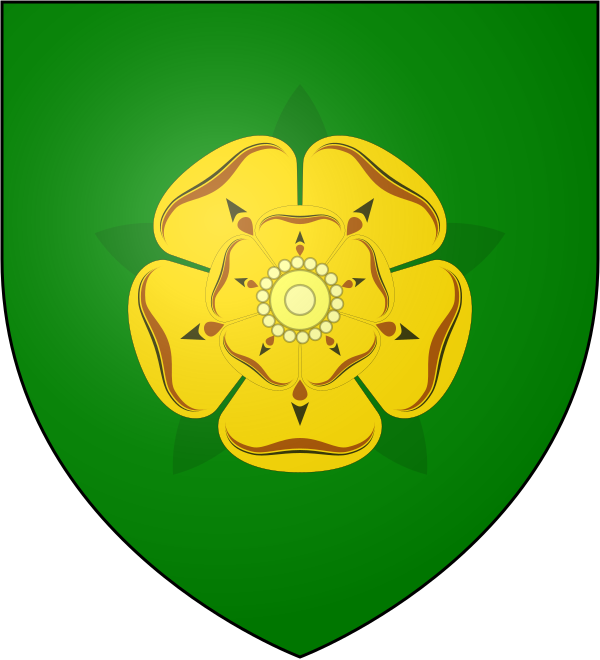
Vert, a rose or
Words Growing Strong
Three words of blazon, every one of them ordinary. The interest is not in what the shield says but in what it does not: it is the only coat among the great houses that records a job rather than a descent.
Lords Paramount of the Mander and Wardens of the South, seated at Highgarden. They were stewards there for centuries before they were lords, and their bannermen have not entirely forgotten it.
Click on a country to learn more
A golden rose on a green field.
Rendered in classical terms: Vert, a rose or.
The sigil and the words are both given in A Clash of Kings, chapter 22 (Catelyn II), where Catelyn sees the Tyrell host and reads its banners.
Three words. No division of the field, no second charge, no posture to specify, no stain or modern tincture to argue about. A metal charge on a coloured field, which is the correct way round and needs no defending.
The heraldic rose has a fixed form that has barely moved in eight centuries: five petals, seen from the front, flat, with small green leaves between the petals (the barbs) and a cluster of seeds at the centre. It is never drawn in profile and never given a stem, unless the blazon says slipped and leaved. It is one of the most standardised charges European heraldry possesses.
Of all the charges borne by the great houses, this is the one a reader is most likely to have met before, and it comes with baggage.
The white rose was a badge of the House of York, well attested and used in their lifetime. The red rose of Lancaster is a more awkward case: it was barely used by the Lancastrians themselves and became prominent chiefly afterwards, when Henry VII needed a red rose to marry to a white one. The combined Tudor rose was, in that sense, a piece of design work done to settle a war retrospectively.
Even the name of the conflict is late. “The Wars of the Roses” is a nineteenth-century coinage, popularised long after the fighting, by writers who found the badges a convenient shorthand.
So the rose arrives in Westeros already carrying two colours and a civil war. The Tyrell rose is neither: it is gold, on green, and it belongs to the richest and most fertile kingdom of the realm rather than to a claimant.
That choice is doing something. A red or white rose would have made the Reach a party to a quarrel. A gold one makes it a prize.
European arms exist to assert descent. They say who your father was, whom your mother brought in, which fiefs came with which marriage. Strip that out and a shield has very little left to do.
The Tyrell shield asserts none of it, and the reason is in the family history.
The founder, Ser Alester Tyrell, was an Andal knight and adventurer, good enough with a sword to be made champion and sworn shield to a King of the Reach. His eldest son died in a tourney. His second son, Gareth, never troubled to be knighted at all and took service as a royal steward instead — and he and his son did the work so well that the office of High Steward was made hereditary.
That is the line today’s Tyrells descend from. Not the knight. The steward.
They kept that office for centuries. Then Aegon Targaryen burned the host of the Reach at the Field of Fire, the last King of the Reach died with it, and Lord Harlan Tyrell yielded Highgarden without a fight. For that, Aegon made him Lord of Highgarden, Lord Paramount of the Mander and Warden of the South.
Other houses of the Reach had older lineages and closer blood ties to the extinct royal house. The Tyrells could claim the founding ancestor of the Reach only through the female line. The bannermen said so out loud, and the phrase they used has stuck to the house ever since: an upjumped steward.
Set that beside the Tullys, raised by the same king in the same war. Both houses owe their rank to Aegon. But the Tullys were lords in their own right who declared first and rode out to fight; the Tyrells were the household staff who opened the gate.
Here is the part that matters heraldically, and it is a negative.
The Kings of the Reach whom the Tyrells served bore Argent, a hand vert — a green hand on white. Their line ended at the Field of Fire. Their seat, their titles and their dominion all passed to their stewards within weeks.
Their arms did not.
The Tyrells took Highgarden and kept the rose. They did not assume the green hand, did not quarter it, did not marshal it into a corner of their own shield, did not even take it as a badge. The arms of the kingdom of the Reach simply stopped.
In Europe, arms follow the fief as often as they follow the blood. A family that acquires a great lordship routinely quarters the arms of that lordship with its own, and goes on quartering, so that a shield ends up as a list of everything the house has ever inherited or married into. It is the single most common way arms grow.
The Tyrell shield has grown not at all. It is the same rose the stewards bore, on the same green, after three centuries of holding the richest kingdom in Westeros. Whether that reads as modesty or as an inability to claim what they never had by blood is left open; but it is unusual, and it is deliberate enough to notice.
The complaint about the upjumped steward has a face, and it has a shield: House Florent of Brightwater Keep, sworn to the Tyrells and openly of the view that Highgarden should have been theirs, on the grounds of closer blood ties to the vanished royal line.
Their arms are Ermine, a fox gules within an annulet of flowers azure — a red fox, ringed with blue flowers, on ermine.
Put the two shields side by side and the argument is visible before a word is said.
So the house with the weaker claim holds the castle, and the house with the stronger one holds the better heraldry. Both shields are correct, and neither can be argued with. They simply say different kinds of thing, and only one of them is saying anything about blood.
Growing Strong.
Most house words have nothing to do with the charge above them. A wolf does not bring winter; sharp blades are not flayed men. The words sit alongside the shield and mean something separate.
Not here. Growing Strong is a description of what a rose does. Charge and motto are the same image stated twice, once in a picture and once in two words, and they reinforce each other rather than adding anything.
Which is convenient, because it also describes the house exactly. A family that began as sworn swords, moved into administration, made the administration hereditary, and was holding the second richest seat in Westeros within a generation of doing nothing at all at the Field of Fire, is a family that grew. The words are not a boast about courage or honour. They are a boast about method.
A golden rose on a green field — in classical terms, Vert, a rose or. The words are Growing Strong and the seat is Highgarden. Both are given in A Clash of Kings, chapter 22.
None. A metal charge on a coloured field is the correct arrangement, and the heraldic rose — five petals seen flat, barbed and seeded — is one of the most standardised charges in European practice. It is the shortest and most orthodox blazon of any great house in Westeros.
It borrows the charge without taking a side. The white rose was a genuine badge of York; the red rose of Lancaster was little used at the time and became prominent mainly afterwards, when Henry VII combined the two into the Tudor rose. The Tyrell rose is gold, which is neither.
No. They were the hereditary High Stewards of the Reach, in the service of its kings. When that line died at the Field of Fire, Lord Harlan Tyrell yielded Highgarden to Aegon the Conqueror without a fight and was made Lord of Highgarden and Warden of the South. Other houses had closer blood ties to the extinct royal house, and said so — the phrase used of the Tyrells was “upjumped steward”.
Nobody knows, and the fact itself is the interesting part. The Kings of the Reach bore Argent, a hand vert, a green hand on white. The Tyrells took the seat, the titles and the dominion, and kept their own rose. A European house acquiring a great lordship would normally have quartered its arms with those of the fief.
A note on method. The heraldic statements above are taken from the books’ own wording where the text gives it. The comparisons with European practice — the form of the heraldic rose, quartering, ermine as a fur, canting arms — are statements about real heraldry, not about the books, and the account of the Yorkist and Lancastrian roses follows the ordinary historical reading rather than the popular one. The television adaptation is not used: it redesigned several sigils, and on a heraldry site the two cannot be mixed.
Last reviewed by the Emblema Mundi editorial team on 28 September 2026.