Westeros Sigil
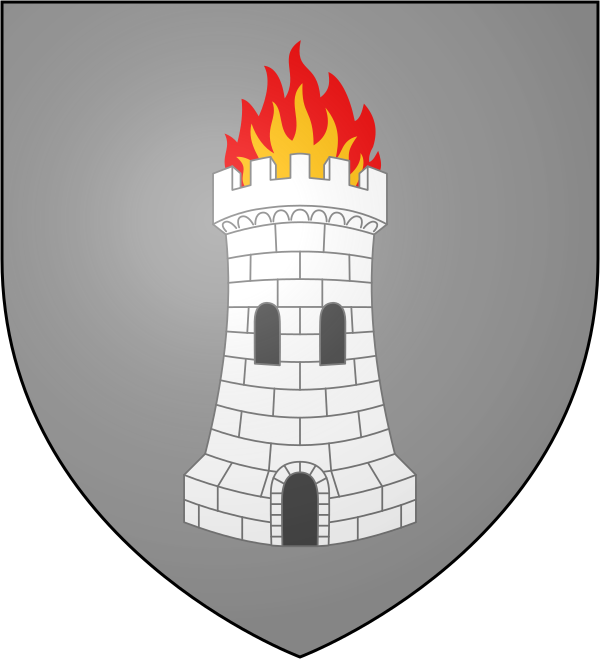
Cendrée, a tower argent, beacon inflamed gules
Words We Light the Way
The only coat in Westeros that works like the arms of a city rather than a family. The charge is not a symbol of anything: it is a building, it is still standing, and the fire on top of it is lit every night.
Lords of Oldtown and of the Hightower, Voices of the Port, Beacons of the South. They were kings in the Dawn Age, they are older and richer than the house they are sworn to, and their arms need the rarest tincture in the atlas.
Click on a country to learn more
A white stone watchtower, with a fire on the top, on smoke grey.
Rendered in classical terms: Cendrée, a tower argent, beacon inflamed gules.
The device appears in The Hedge Knight, and the words in the appendix to A Feast for Crows. It is one of the arms the setting shows at a tourney rather than merely listing.
Look at the tinctures in order: an ash-grey field, a white tower, and a red fire. The first two are both pale — a white charge on a smoke-grey ground is not the flat contradiction of grey on white, but it is not far off, and a herald would have raised an eyebrow.
What saves it is the flame. The beacon is gules, and it sits at the very top of the charge, where the eye goes first. It is the one strong colour in the coat, and it is placed exactly where it is needed.
The same thing happens on the Martell shield, where a gold spear rescues a red sun on orange. Two houses at opposite ends of the continent, both with arms that would fail on their own, both saved by a single third element in the right place.
Grey is not one of the heraldic colours. The armorials fix a short list — gules, azure, sable, vert, purpure — and ash grey is not on it. There is a word, cendrée, which the reference works acknowledge and which practising heralds have almost never used.
In this whole atlas it is needed exactly twice, and both times for a Westerosi house: here, and for the direwolf of Winterfell.
They look alike and behave differently, which is what makes the pair worth setting side by side.
Same rare tincture, same underlying problem, opposite outcomes. One coat fails the test of distance; the other passes it, by the width of a beacon.
Towers are ordinary in European arms. Castles, gates, keeps, turrets: the repertoire is full of masonry, and heralds have a precise vocabulary for it — a tower is embattled, masoned, port and windows sable, and so on.
A tower with a fire burning at the top is a different object. That is not a fortification, it is a lighthouse, and its purpose is the opposite of a castle’s: a keep exists to keep people out, a beacon exists to bring them in.
European heraldry does bear lighthouses, and the great example is a genuine Roman one. The Tower of Hercules at A Coruña, on the Galician coast, is the oldest lighthouse still working anywhere, and the city puts it on its arms. Before it there was the Pharos at Alexandria, the building every later lighthouse is measured against.
The Hightower is Westeros’s Pharos, down to the detail: it stands at the mouth of a river, at the edge of the known world, at the head of the largest port and the oldest city in the realm. And the family history keeps the beacon at the centre — four wooden towers were raised and replaced before the fifth was built in stone, each one a beacon before it was a seat.
Which means the arms record a working piece of infrastructure. Most charges in this atlas stand for courage, descent or a pun. This one stands for a fire that has to be lit tonight.
There are two kinds of European coat, and they do different jobs. Family arms say who you descend from. Civic arms say what a place is — and they are full of buildings, because a town’s bridge, gate or tower is the thing everyone recognises.
Almost every shield in Westeros is the first kind. The Hightower arms are the second, and they are the only ones that are.
And the habit runs deeper than the shield. The ancestral Valyrian steel sword of the house is named Vigilance — which is not a boast about swordsmanship, but a description of what a lighthouse does. The arms, the titles, the motto and the sword all say the same word.
One fact reframes the rest. The Hightowers are sworn to House Tyrell.
Set the two histories next to each other. The Hightowers were petty kings in the Dawn Age, before the First Men by one reading of the chronicles; their founder is a king out of legend, and the fifth tower is said to have been designed by the builder of the Wall. The Citadel itself was founded by that king’s sons. Their city is the oldest in Westeros and holds the Faith’s first great sept.
Their overlords were hereditary stewards who were granted Highgarden in 2 BC for opening a gate.
In European heraldry, precedence of this kind leaves marks. An ancient house sworn to a newer one keeps the older arms and the older style, and the fact of antiquity is itself a claim — heralds recorded it, and families litigated over it for centuries.
Neither shield here says a word about it. The tower does not claim priority; the rose does not claim precedence. The two coats are simply borne, one under the other, and the whole difference in age and wealth between the houses is invisible on the field.
We Light the Way.
Like the rose and its motto elsewhere in the Reach, charge and words are the same image said twice. The tower burns; the words say the house lights the way. Nothing is added.
But read the sentence again and notice what kind of claim it is, because it is unusual. Every other house motto in this atlas is about the house: what it will do, what it has endured, what it owns, what it owes. These words are about someone else.
“We light the way” has no meaning without a traveller in the dark. It describes a service rendered to people the house does not name, and who are not there. For a family that has held the oldest city in Westeros for longer than any dynasty in the realm, and has spent most of that time trading rather than fighting, it is the most accurate motto in the book.
A white stone watchtower with a fire burning at the top, on a smoke-grey field — in classical terms, Cendrée, a tower argent, beacon inflamed gules. The words are We Light the Way and the seat is the Hightower, in Oldtown.
An ash grey that the armorials acknowledge without really using. Grey is not one of the heraldic colours, so a grey tincture has to be reached for specially. In this atlas it is needed exactly twice: for the Hightower field, and for the direwolf of Winterfell.
They come close and then recover. A white tower on an ash-grey field is two pale tones together, which a herald would question. The red flame at the top of the tower supplies the one strong colour in the coat, and it sits exactly where the eye goes first.
Yes. The best known is the Tower of Hercules at A Coruña in Galicia, a Roman lighthouse still in service, which the city bears on its arms. The Hightower plays the part the Pharos of Alexandria plays in the real world: the beacon at the mouth of the greatest port.
Because overlordship in Westeros follows the grant of a king, not the age of a house. The Hightowers were petty kings in the Dawn Age and founded the Citadel; the Tyrells were hereditary stewards granted Highgarden in 2 BC. Neither shield records the difference.
A note on method. The heraldic statements above are taken from the books’ own wording where the text gives it, and the disputed origin of the family — First Men, or earlier seafarers — is given as disputed. The comparisons with European practice — cendrée, the vocabulary of towers, civic as against family arms, the Tower of Hercules — are statements about real heraldry and real buildings, not about the books. The television adaptation is not used: it redesigned several sigils, and on a heraldry site the two cannot be mixed.
Last reviewed by the Emblema Mundi editorial team on 28 September 2026.