Westeros Sigil
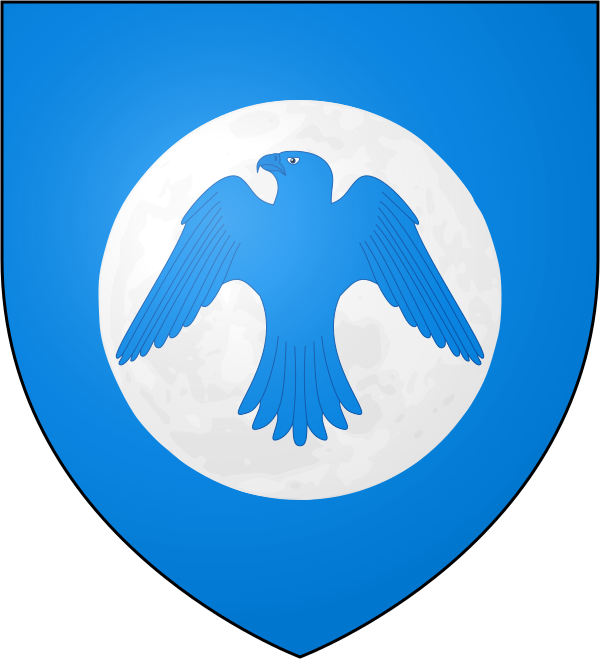
Bleu celeste, upon a plate a falcon rousant of the field
Words As High as Honor
The most sophisticated shield in Westeros, and the only one built in three layers. The falcon is the same colour as the ground it flies against — take away the white disc between them and the bird disappears.
Wardens of the East and Lords of the Eyrie, the stronghold at the top of the Giant’s Lance. They claim the oldest and purest Andal blood in Westeros, and their arms are older than their crown.
Click on a country to learn more
A sky-blue falcon soaring against a white moon, on a sky-blue field.
Rendered in classical terms: Bleu celeste, upon a plate a falcon rousant of the field.
The sigil and the words are both given in A Game of Thrones, chapter 40 (Catelyn VII), as Catelyn comes up to the Eyrie. The reference works add the classical form, and the author has also spoken about these arms outside the novels.
Four words in that blazon are doing real work, and none of them was coined for these books.
Almost every coat in this atlas is two layers: a field, and something on it. The Arryn arms are three, and the middle one is there for a reason.
Follow what that does. A sky-blue falcon on a sky-blue field would be invisible — the worst possible breach of the rule that arms must read at a distance. The plate is what makes the bird exist. It is not decoration behind the falcon; it is the only reason there is a falcon to see.
And the effect is exactly what the words describe: a bird outlined against the moon. The heraldry and the image agree, which is rarer than it sounds.
European heralds call this a charge upon a charge, and they are careful with it, because each layer has to satisfy the rule separately. The Arryn arms satisfy it twice. No other great house in the setting attempts the construction at all.
Sky blue is not azure. Azure is the deep blue of the medieval palette, one of the handful of colours the armorials fix. Bleu celeste is a separate, much later tincture — recognised in English practice, but essentially a modern addition, granted mostly in the twentieth century and associated above all with air force arms, where a sky was wanted rather than a sea.
So the Arryns are in the same position as the Martells with tenné: a tincture that has a proper name and almost no history of use. The difference is that theirs is rare because it is new, not because it was avoided.
The second oddity is what happens to the moon in translation. English blazon names its roundels by tincture, each with its own word: a bezant is gold, a torteau red, a hurt blue, a pellet black — and a plate is silver.
Heraldry does have a moon: a moon in her plenitude, usually drawn with a human face. The Arryn arms do not use it. What the books call a white moon, blazon calls a plain silver disc — and the plainer reading is the better one here, because the disc is working as a backdrop, not as a celestial body.
European heraldry expects a cadet branch to keep the family arms and difference them — a bordure, a label, a changed tincture — so that the shield says both of that house and not the head of it. The Arryn cadets are the most interesting case in Westeros, because nobody is sure what they did.
House Arryn of Gulltown split from the main line during the reign of Jaehaerys I, went into trade, married merchants and grew rich — rich enough that after the death of Lady Jeyne Arryn, its head Isembard Arryn put himself forward as a claimant to the Eyrie itself, bribing lords and hiring sellswords, before being forced to submit and ending up master of coin.
Isembard’s nickname was the Gilded Falcon, and the reason given is his wealth: men japed that the falcon on his arms was made of gold.
The reference works record his personal arms as Bleu celeste, upon a plate a falcon rousant or — a gold falcon where the Eyrie’s is sky blue.
If that is right, it is remarkable. Changing the tincture of the principal charge is one of the standard European ways of differencing a cadet branch: keep the composition, alter one colour, and the shield says of that house, not the head of it. It would be the only clean example of correct differencing this atlas has found anywhere in Westeros.
Because the same reference works say the opposite elsewhere. Their entry for the Gulltown branch states that the arms are the same as the Eyrie’s, reasoning from the very same detail about the gilded falcon. The two statements cannot both hold: a gold falcon is not a sky-blue one.
What is certain is the thing underneath: the books never blazon the Gulltown arms. Everything else is inference from a nickname. This site would rather say so than pick the tidier answer.
The Arryns claim the oldest and purest line of Andal nobility in Westeros, tracing back across the narrow sea to Andalos. Their founder is Ser Artys Arryn, born in the shadow of the Giant’s Lance, who led the Andals against the First Men of the Vale at the Battle of the Seven Stars and was crowned the first King of Mountain and Vale.
The detail that matters here is the order of events. Artys was already called the Falcon Knight before he was king, because of what he carried: the moon-and-falcon on his shield, and a pair of falcon’s wings on his silver warhelm.
Those wings are worth stopping on. In European heraldry the crest — the device worn on top of the helm, distinct from the shield — is a full part of an achievement of arms, and often the part people recognised on a battlefield.
Westerosi heraldry is overwhelmingly a heraldry of shields and banners; crests are barely mentioned. Artys Arryn wearing his falcon on his helm, and the Tully guards in their fish-crest helms, are among the few places where the setting shows arms behaving as they did in life — leaving the shield and appearing on the armour, the household, the furniture.
So the arms are older than the kingship, and older than the Seven Kingdoms. Legend went further and folded Artys together with the Winged Knight, a hero of the Vale from thousands of years before the Andals ever landed — which is to say the Arryns ended up with a founder who is partly a man and partly a much older story, and the wings on the helm are the join.
As High as Honor.
Most house words in this atlas are figures of speech. These are a measurement.
The Eyrie stands at the top of the Giant’s Lance, the tallest mountain in the Vale, reached by a climb that takes most of a day; the Arryns keep a second castle, the Gates of the Moon, at the bottom of the same mountain for the winter. No house in Westeros lives higher. The words say that honour is as high as that — and they are said by the people who know exactly how high that is.
Set against the others, the difference in register is plain. Winter Is Coming is a warning, Unbowed, Unbent, Unbroken a denial, Our Blades Are Sharp a remark about equipment, Family, Duty, Honor an order of precedence. As High as Honor is a comparison — and the house supplies the thing being compared to.
A sky-blue falcon soaring against a white moon, on a sky-blue field — in classical terms, Bleu celeste, upon a plate a falcon rousant of the field. The words are As High as Honor and the seat is the Eyrie. Both are given in A Game of Thrones, chapter 40.
Because it is not on the background. It sits on the white moon, which in blazon is a plate, a silver roundel. Metal on colour, then colour on metal: each layer satisfies the rule of tincture separately. Remove the plate and a sky-blue falcon on a sky-blue field would be invisible.
Yes, but a late one. It is distinct from azure, the deep blue of the medieval palette, and is recognised in English practice mainly as a modern addition, granted above all in aviation arms where a sky was wanted rather than a sea.
The books never blazon them, so the honest answer is that nobody knows. Isembard Arryn, who headed the branch and claimed the Eyrie, was called the Gilded Falcon because men japed that his falcon was gold, and the reference works record his arms with a falcon or — which would be a proper mark of difference. The same works also state elsewhere that the Gulltown arms are identical to the Eyrie’s. Both cannot be true.
A legendary hero of the Vale from thousands of years before the Andals arrived. Ser Artys Arryn, the Andal knight who founded the house and won the Battle of the Seven Stars, wore falcon’s wings on his helm and was called the Falcon Knight; the tales later folded the two figures together.
A note on method. The heraldic statements above are taken from the books’ own wording where the text gives it, and marked as an inference or an out-of-book statement where that is what they are — the Gulltown arms in particular, which the novels never blazon. The comparisons with European practice — bleu celeste, the roundels, rousant, a charge upon a charge, crests, marks of difference — are statements about real heraldry, not about the books. The television adaptation is not used: it redesigned several sigils, and on a heraldry site the two cannot be mixed.
Last reviewed by the Emblema Mundi editorial team on 28 September 2026.