Country
Brazil's national emblems were born of a single Republican moment — November 1889 — but the colours that frame them are Imperial. The green-and-yellow flag kept the lozenge of the 1822 monarchy and overlaid it with a celestial sphere charting the night sky of Rio de Janeiro on the morning of the Republic's proclamation, crossed by the Comtist motto Ordem e Progresso. The coat of arms, designed in the same weeks, surrounds the new star-field with branches of coffee and tobacco — the two crops that financed the nineteenth-century empire.
Click on a country to learn more
| Country | Federative Republic of Brazil (República Federativa do Brasil) |
|---|---|
| Coat of arms adopted | 19 November 1889 (Decree 4 of the Provisional Government); current form set by Law 5,700 of 1 September 1971, as amended |
| Flag adopted | 19 November 1889, four days after the Proclamation of the Republic |
| Designers (flag) | Raimundo Teixeira Mendes, Miguel Lemos, Manuel Pereira Reis, Décio Villares |
| Flag colours | Green, gold, blue, white |
| Motto | Ordem e Progresso (Order and Progress) |
| Number of stars | 27 (26 states + Federal District) |
The national flag from the Empire to today — click the thumbnails.
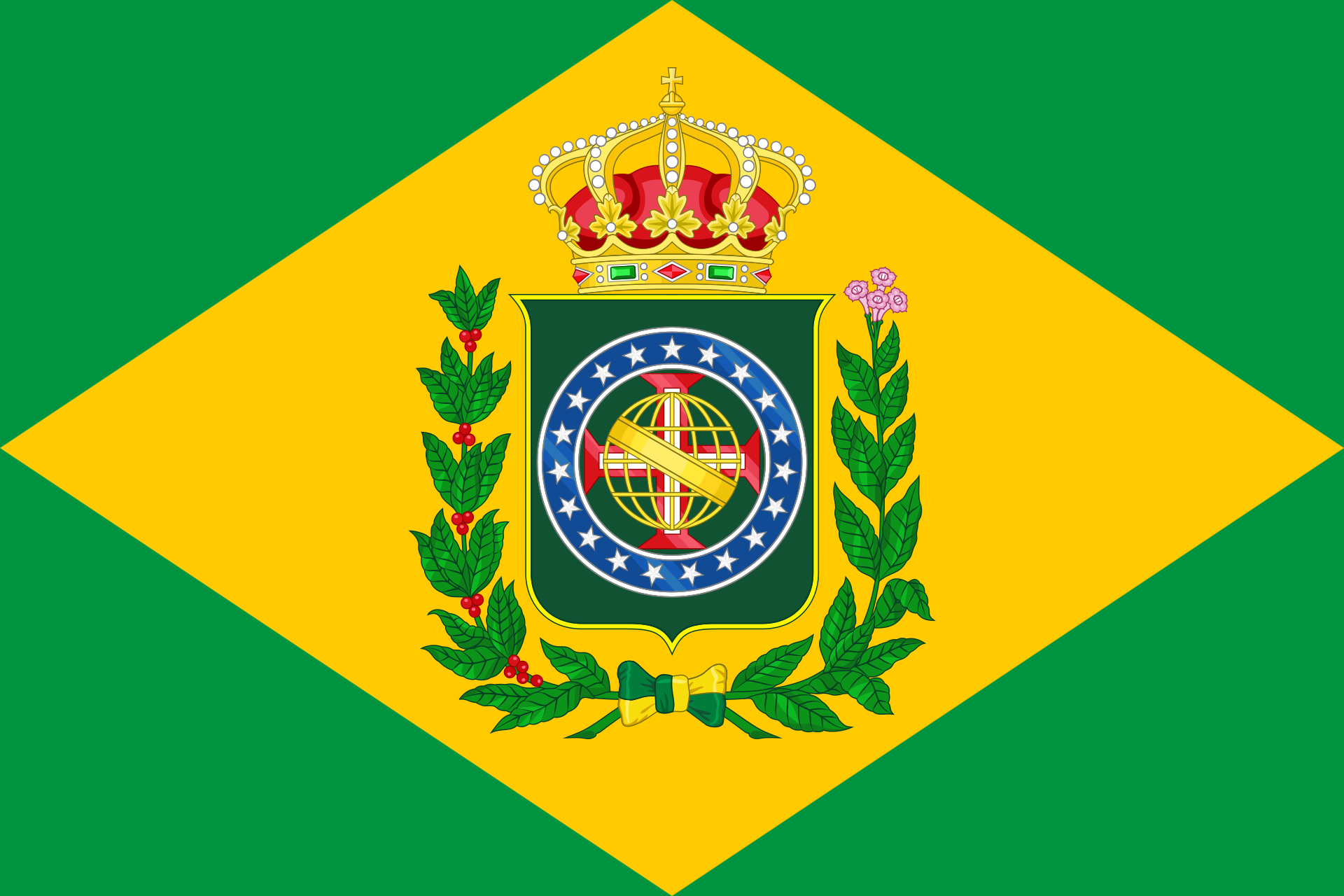
Designed by Jean-Baptiste Debret and adopted just after independence, the imperial flag set the green of the House of Bragança and the yellow of the House of Habsburg-Lorraine in a lozenge. At the centre, the imperial arms: the armillary sphere, the cross of the Order of Christ, the crown and a ring of stars.
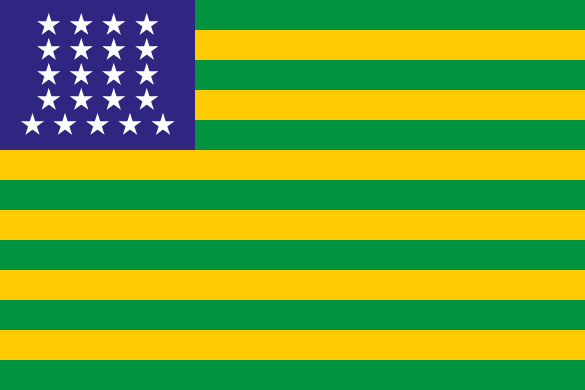
When the Republic was proclaimed, a flag in the style of the United States went up: thirteen green and yellow stripes and a blue canton with stars. It flew from 15 to 19 November, when Marshal Deodoro da Fonseca vetoed it.
Decree 4 of 19 November 1889 kept the green and the lozenge of the Empire — a sign of continuity — but replaced the imperial arms with a celestial sphere showing the sky of Rio on 15 November 1889 and the motto Ordem e Progresso.
Brazil's tricolour heritage begins not with the Republic but with the Empire. When Pedro I proclaimed independence on the banks of the Ipiranga on 7 September 1822, his court painter Jean-Baptiste Debret designed an imperial flag: a green field charged with a gold rhombus (lozenge), and at the centre a shield bearing the imperial coat of arms.
The colours were dynastic, not territorial:
The lozenge form was inspired by Napoleonic French heraldic style, then prestigious across Europe. The green had nothing to do with forests and the yellow nothing to do with gold: that naturalist reading is a later reinterpretation.
Two flags of November 1889 are often confused. A design by the Republican Lopes Trovão was raised when the Republic was proclaimed; it was soon replaced by a similar proposal by the jurist Ruy Barbosa, strongly inspired by the flag of the United States. That flag flew from 15 to 19 November, when Marshal Deodoro da Fonseca, acting as provisional president, vetoed it.
Decree 4 of 19 November 1889 adopted instead a design that kept the green field and gold lozenge of the Empire, as a sign of continuity, but replaced the imperial arms with a blue celestial sphere bearing the Southern Cross, the stars of the federation and the motto Ordem e Progresso.
The design was the work of four Positivist intellectuals:
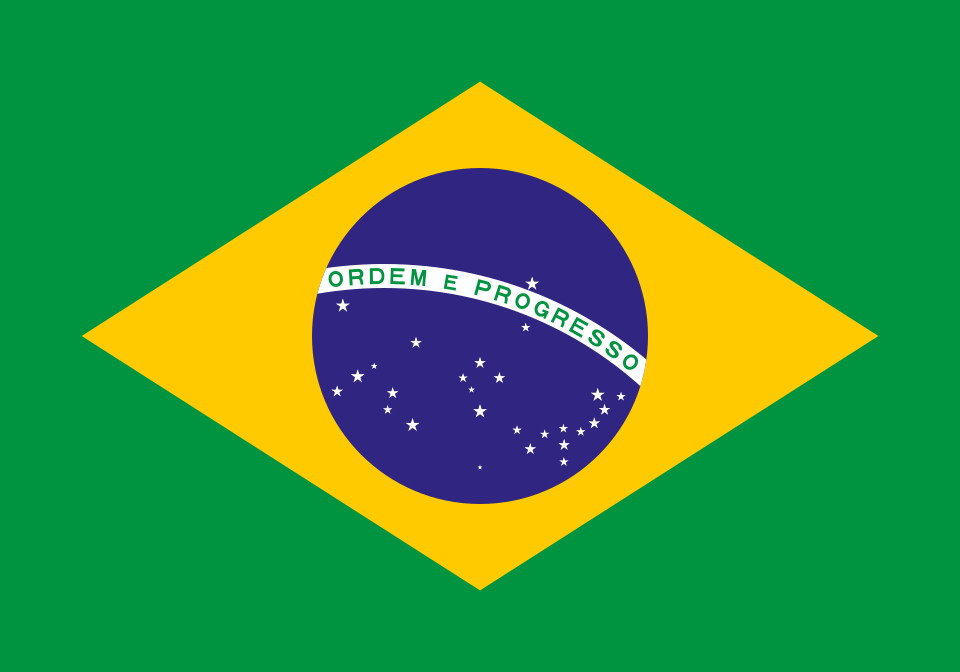
The blue circle is a celestial sphere showing the sky of Rio de Janeiro on the morning of 15 November 1889 at 08:30 — twelve sidereal hours — the moment when the imperial government formally fell. Pereira Reis selected the exact star pattern by reconstructing the local sidereal time on that morning.
One detail is regularly got wrong, and the statute is explicit about it: the stars are to be read as seen by an observer placed outside the celestial sphere, not from the ground at Rio. The sky on the flag is therefore mirrored with respect to what a Carioca saw that morning.
The stars depicted belong to the Southern Cross, Sigma Octantis, Canis Major, Procyon (Canis Minor), Canopus (Carina), Spica (Virgo), Hydra, Triangulum Australe and Scorpius. Each star stands for a federal unit — Acre, for instance, is Gamma Hydrae. The likeness to the real sky is only rough: bright constellations such as Centaurus are left out entirely.
Sigma Octantis, the south pole star, represents the Federal District. It is small, but all the other stars turn around it: its unique position in the southern sky stands for the stability of the capital within the Union.
Spica (Alpha Virginis) is the only star placed above the white band with the motto. It represents the state of Pará and the part of Brazil that lies in the northern hemisphere.
The white band across the sphere bears the motto ORDEM E PROGRESSO (Order and Progress) in green letters. It is an abbreviation of the celebrated formula of the French philosopher Auguste Comte (1798–1857), founder of Positivism:
L'amour pour principe et l'ordre pour base ; le progrès pour but.
(Love as principle and order as basis; progress as goal.)
Brazilian Positivism was an unusually influential intellectual movement in the 1870s–1890s — far more so than in Comte's native France. Its adherents dominated the Republican founding circles and the new army general staff. The choice of motto was a public profession of Positivist faith — and a deliberate secularisation. It replaced no imperial motto: the arms of the Empire carried none. Independência ou Morte, often quoted as though it had been one, is the cry of the Ipiranga, never a legend borne on the imperial shield.
Follow the evolution of the arms of Brazil — click the thumbnails.
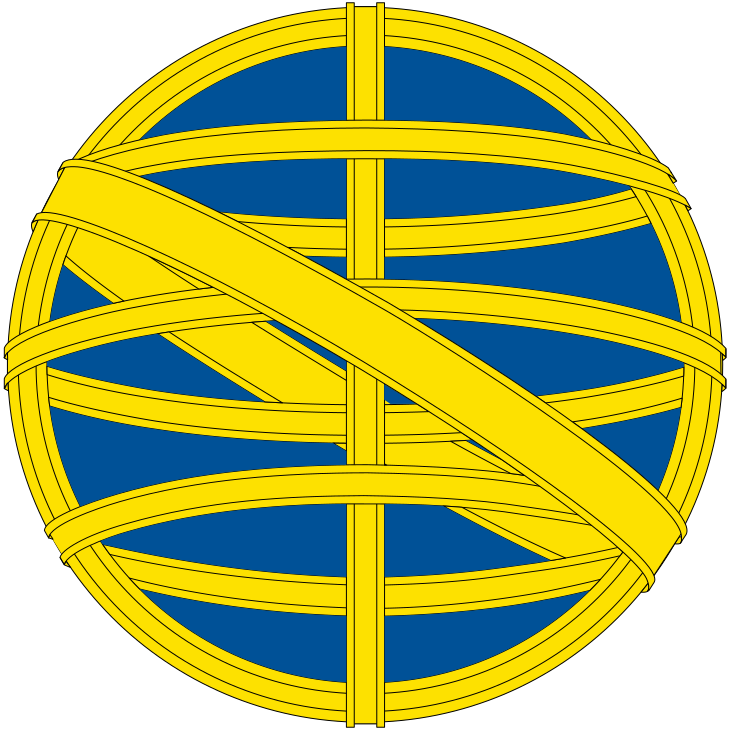
Azure, an armillary sphere Or.
On 16 December 1815 the State of Brazil was raised to the rank of a kingdom, so that a political union with the Kingdom of Portugal and the Algarves would be legally possible. The carta de lei of 13 May 1816 gave it arms: «que o Reino do Brazil tenha por Armas uma esphera armilar de ouro em campo azul» (that the Kingdom of Brazil have for its arms a gold armillary sphere on a blue field). The armillary sphere had already been given to Brazil in 1645: King João IV, after raising Brazil to a Principality, gave it a Manueline armillary sphere as arms, used on a white field as the distinctive flag of the Principality of Brazil.
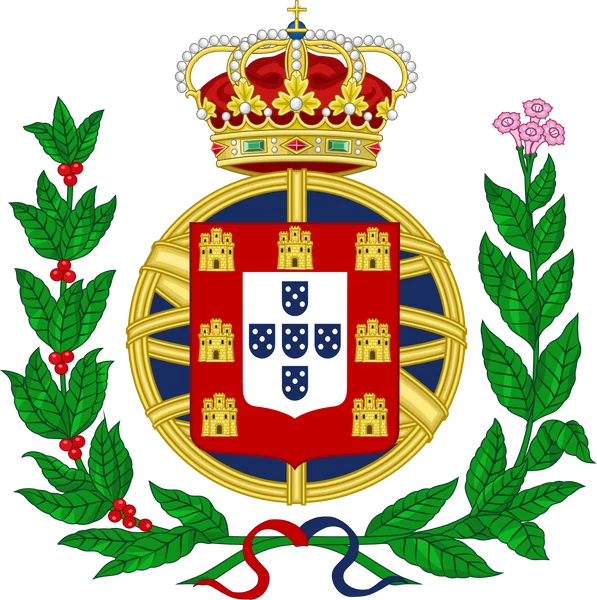
The Portuguese royal shield, inscribed within the gold armillary sphere on a blue field, with a crown above.
The same carta de lei of 13 May 1816 combined the Portuguese royal shield with the sphere of Brazil: the royal shield, inscribed within the sphere and surmounted by a crown, became «de hoje em diante as armas do Reino Unido de Portugal e do Brasil e Algarves» (from this day forward the arms of the United Kingdom of Portugal, Brazil and the Algarves). These were the arms to be used «em todos os estandartes, bandeiras, sellos reaes e cunhos de moedas» (on all standards, flags, royal seals and coin dies).
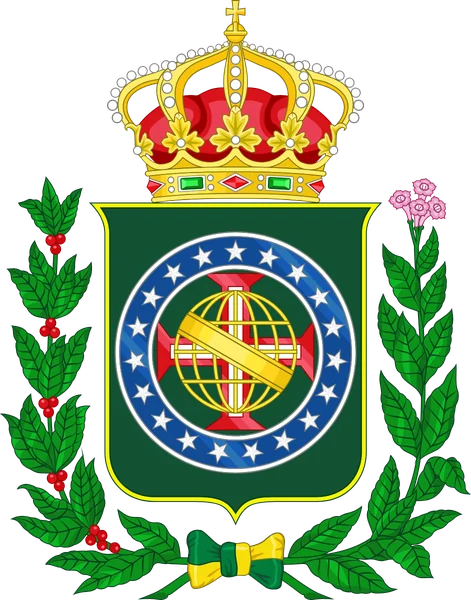
Vert, an armillary sphere Or over a cross of the Order of Christ, within a ring Azure charged with nineteen stars Argent; the shield ensigned with the royal crown.
The decree of 18 September 1822 gave Brazil a new shield, with two branches «das plantas de Caffé e Tabaco, como Emblemas de sua riqueza comercial» (of the coffee and tobacco plants, as emblems of its commercial wealth), tied by the bow of the Nation. These arms were first the device of the personal standard of the Prince Royal, created by the French painter Jean-Baptiste Debret at the request of Pedro de Alcântara, already Prince Regent. From September to December 1822 the shield was surmounted by the royal crown, because it was planned to keep Brazil a kingdom, though independent.
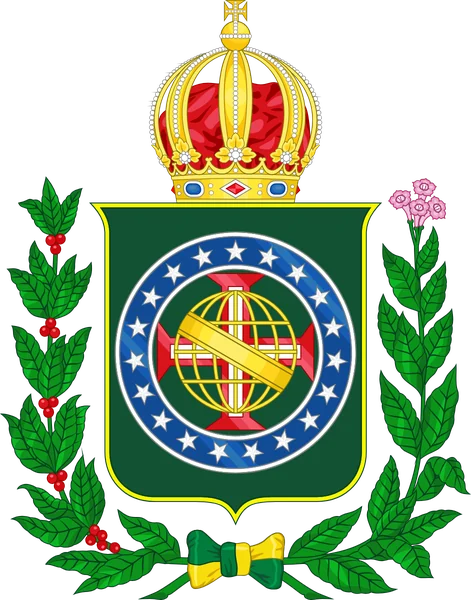
Vert, an armillary sphere Or over a cross of the Order of Christ, within a ring Azure charged with nineteen stars Argent; the shield ensigned with the imperial crown.
With the coronation of Pedro as emperor at the end of 1822, the royal crown gave way to the imperial crown. The arms kept Portuguese elements: the armillary sphere, used since the 17th century on the standard of the Princes of Brazil, and the cross of the Order of Christ, already combined with the sphere on coins struck in the colony since at least 1700. The nineteen stars represented the provinces of the time. With the creation of the province of Paraná in 1853, the arms came to have twenty stars; on the coins, however, there were always nineteen until 1889, and on the printing blocks (clichés) of the Imprensa Nacional nineteen until 1879.
On a sky-blue field, five silver stars in the form of the Southern Cross; the bordure outlined in gold, charged with silver stars equal in number to the stars of the national flag.
Decree 4 of 19 November 1889 did not describe the arms: «As armas nacionaes serão as que se figuram na estampa annexa n. 2» (the national arms shall be those shown in the attached plate no. 2). The republican arms kept much of the imperial ones: the Southern Cross replaced the cross of the Order of Christ, the blue circle replaced the armillary sphere, and the coffee and tobacco branches and the ring of stars of the units of the Federation remained. The green and yellow ribbon became blue, and the five-pointed star, a republican symbol, and the sword, a military symbol, were added. According to Law 5,700 of 1971 (amended by Law 8,421 of 1992), the national arms are those of the 1889 decree, with the changes made by the laws of 1968 and 1992.
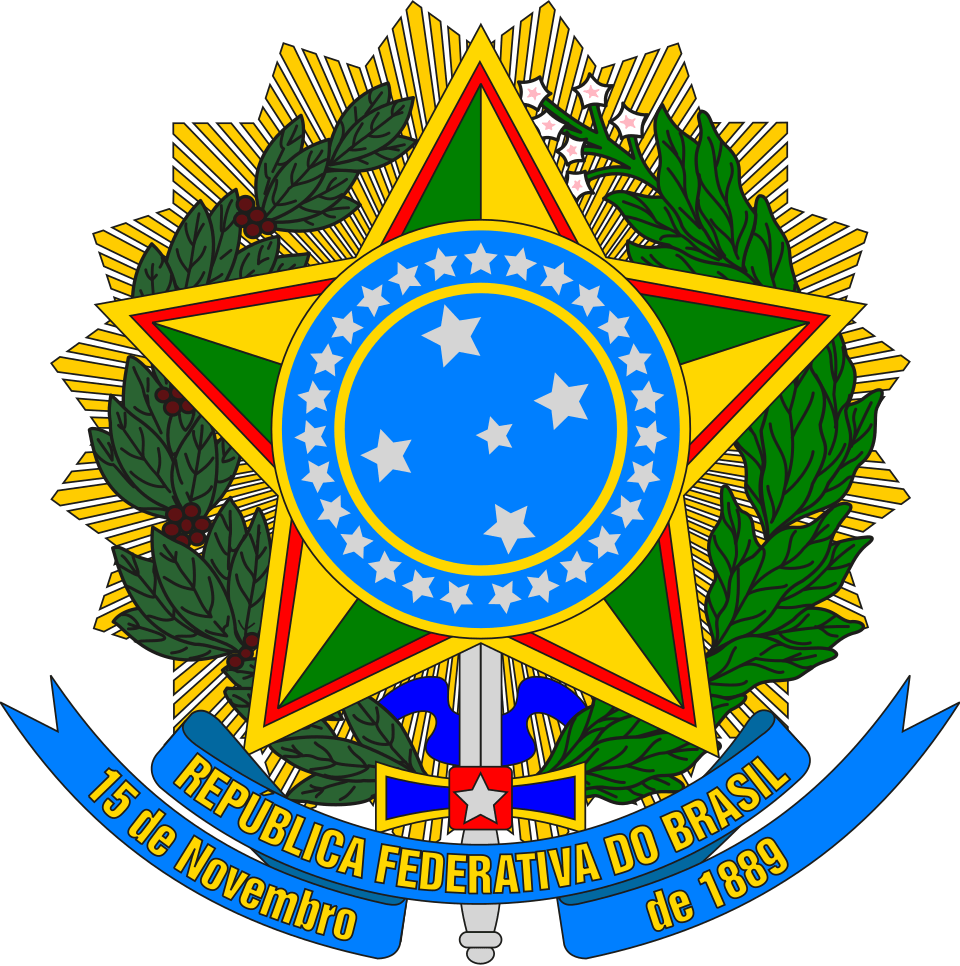
Coat of Arms — A blue circular shield with the Southern Cross and the stars of the federation, framed by coffee and tobacco branches.
The Brazilian coat of arms differs from most European national arms: it is built not from a feudal shield but from a circular medallion in the late-nineteenth-century neoclassical style. At its heart, a sky-blue field carries five silver stars set in the form of the Southern Cross (Crux). The field is edged with a gold-outlined bordure, and it is on that bordure — not in the field — that the silver stars of the Federation are placed, « in number equal to the stars on the national flag », today 27. Unlike the flag, the arms do not reproduce the sky of 15 November 1889: the law fixes only their number.
The shield rests on a large five-pointed star that is not gold but gyronny of ten, vert and or — green and gold in alternating rays — edged with two fillets, the inner gules and the outer or. Behind the whole radiates a gold resplendor whose outline forms a twenty-pointed star. Behind the shield rises the hilt of a ceremonial sword, point upward, emerging through the lower edge. The composition is supported by two crossed branches tied at the base: a coffee branch on the dexter side (the viewer's left) and a tobacco branch on the sinister side (the viewer's right), recalling the two staple exports of the imperial economy.
A single blue ribbon crosses over the sword hilts and carries, in gold, the legend REPÚBLICA FEDERATIVA DO BRASIL in the centre, 15 de Novembro at the dexter end and de 1889 at the sinister — the date of the Republican Proclamation.
Each silver star on the inner blue field represents a constituent of the Federation. The original 1889 design carried 21 stars — one for each of the provinces inherited from the Empire plus the federal capital district. The arms were updated as new states were created:
It is the flag, not the arms, that reproduces the sky of Rio at 08:30 on 15 November 1889. For the arms, the law only requires the stars of the bordure to match the flag in number.
Each of Brazil's 27 federal units has its own coat of arms and flag. Most were designed during the First Republic (1889–1930) and reflect a regional iconography of natural resources, indigenous heritage, and Republican ideals. Some of the best known:
Every state has its own page on the interactive map above, with its arms, its flag and their history.
Most Brazilian state arms follow a common pattern established in the 1890s under the influence of Positivism: a circular or oval shield in a neoclassical frame, with natural products of the state (sugar cane, coffee, palm trees, gold ore) and a mural crown or laurel wreath. The standardisation was less formal than in Portugal but no less consistent — a quiet declaration that the new Republic broke with European medieval heraldic conventions.
The colours were inherited from the Imperial flag of 1822 designed by Jean-Baptiste Debret. Green stood for the House of Bragança of Emperor Pedro I, and yellow for the House of Habsburg-Lorraine of his wife Empress Maria Leopoldina. After 1889, the Republic kept the colours but reinterpreted them as nature symbols — the green of the Amazonian forest and the gold of the country's mineral wealth.
Ordem e Progresso (Order and Progress) is a Positivist motto inspired by Auguste Comte's principle “L'amour pour principe et l'ordre pour base ; le progrès pour but”. The Brazilian Republican founders, many of them Comtist Positivists, chose it to express the secular and rationalist ideals of the new regime.
The stars on the blue celestial sphere depict the night sky over Rio de Janeiro at 08:30 on 15 November 1889 — the morning of the Proclamation of the Republic. Each star represents a state or the Federal District; the number has grown from 21 in 1889 to the current 27, with stars added in 1960, 1968 and 1992.
It is Spica, Alpha Virginis. It represents the state of Pará and the part of Brazil that lies in the northern hemisphere. The Federal District is represented by Sigma Octantis, the south pole star.
A committee of Positivist intellectuals: Raimundo Teixeira Mendes, Miguel Lemos, the astronomer Manuel Pereira Reis and the painter Décio Villares. They preserved the green field and yellow rhombus of the Imperial flag and replaced the imperial coat of arms in the centre with the blue celestial sphere and the positivist motto.
A coffee branch (on the dexter side) and a tobacco branch (on the sinister side) — the two staple agricultural exports that drove Brazil's nineteenth-century economy. They are tied at the base by a blue ribbon bearing the name of the Republic and the date 15 November 1889.
The national symbols did not. But the Estado Novo (1937–1945), hostile to regionalism, forbade the symbols of the states: the state flags were burned in a civic ceremony in Rio de Janeiro. They were allowed again under the Constitution of 1946.
Arms: Wikimedia Commons. Arms of the Kingdom of Brazil (Giro720) and of the United Kingdom of Portugal, Brazil and the Algarves (117-M-I-K-E, converted to WebP): CC BY-SA 4.0; arms of 1822 and current arms: public domain.
Last reviewed by the Emblema Mundi editorial team on 5 October 2026.