Historic County · England
Yorkshire flies one of the most recognisable emblems in England: the White Rose of York on a blue field. The rose is no invention of tourism — it is the medieval badge of the House of York, worn in the Wars of the Roses against the red rose of Lancaster, and it has stood for England's largest historic county ever since. Even the county's old threefold division into Ridings is a Viking inheritance from the days when York was the Norse capital of Jórvík.
Click on a country to learn more
| Country | England (United Kingdom) |
|---|---|
| Nicknames | God's Own County; the Broad Acres |
| Emblem | The White Rose of York |
| Flag registered | 29 July 2008 (Flag Institute) |
| Yorkshire Day | 1 August |
| Historic divisions | Three Ridings: East, North, West |
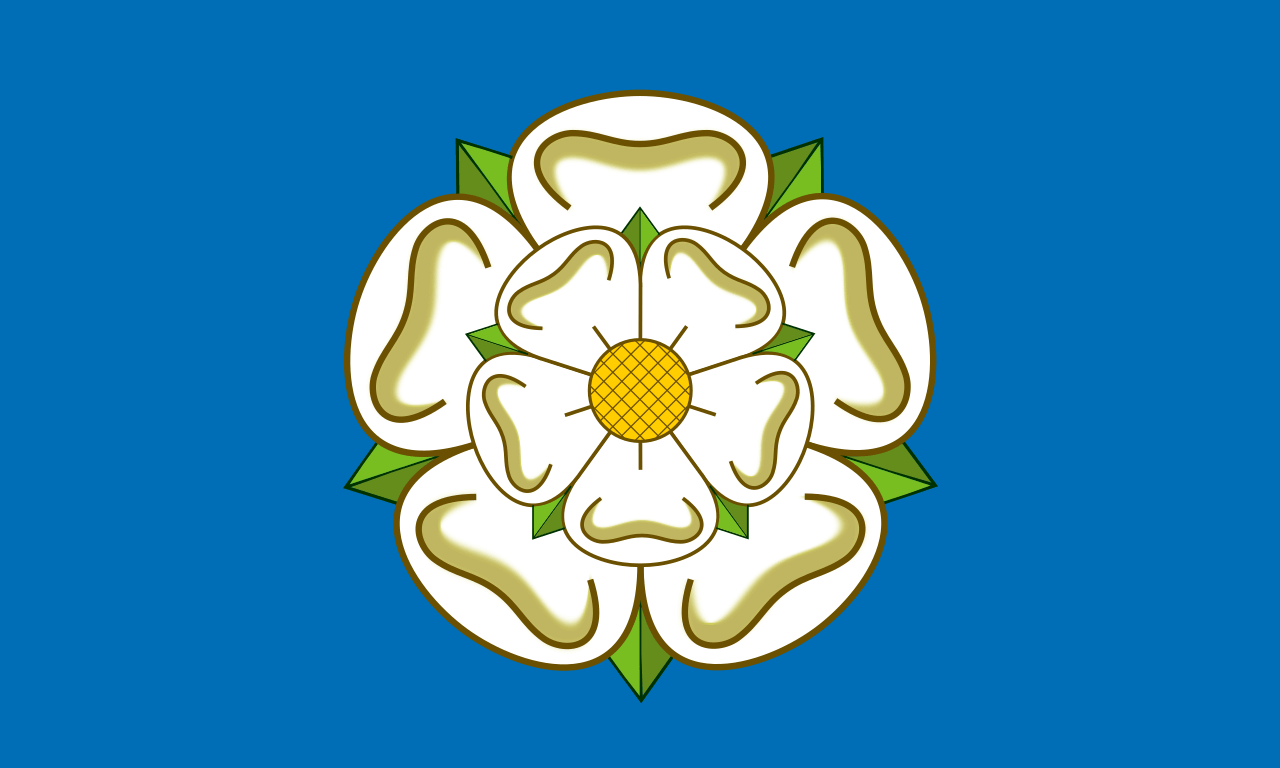
Flag of Yorkshire — the White Rose of York on a blue field
The flag is simplicity itself: a single white rose of York centred on a blue field. The rose is drawn as a heraldic rose — five petals, five green barbs between them, and a golden centre (seeded Or, barbed Vert).
Though the white rose is medieval, the flag as such is modern. The design had circulated since at least the 1960s and was promoted by the Yorkshire Ridings Society from the mid-1970s; it was formally entered on the Flag Institute's UK registry on 29 July 2008. The blue field has no ancient meaning — it is usually traced to the dark blue of Yorkshire County Cricket Club and the county's regiments, giving the rose a strong, plain ground to sit on.
The white rose (rosa alba, the "Rose of York") was the heraldic badge of the House of York, the branch of the Plantagenet dynasty that contested the English crown with the House of Lancaster in the Wars of the Roses (1455–1487). Lancaster's badge was a red rose; York's was white, and the wars have been named after the two flowers ever since.
King Edward IV, the first Yorkist king, favoured a particular version — the rose-en-soleil, a white rose set upon a blazing golden sun. When the wars ended and Henry VII married Elizabeth of York, the two roses were fused into the red-and-white Tudor Rose. But the plain white rose lived on, no longer as a dynasty's badge but as the emblem of a whole county.
Yorkshire is the largest of England's historic counties, and for a thousand years it was divided not into halves or quarters but into three: the East, North and West Ridings. The word looks like "riding a horse," but it is nothing of the kind — it comes from the Old Norse þriðjungr, "a third." A riding is, literally, a "thirding."
That Norse word is a fingerprint of the Viking Danelaw: in the ninth and tenth centuries York — Norse Jórvík — was the capital of a Scandinavian kingdom, and the administrative geography the Vikings left behind outlasted them by a millennium. Each of the three ridings later received its own registered flag in 2013, but all three still gather under the single white rose.
The flag of Yorkshire is a white rose of York centred on a blue field. It was officially registered with the Flag Institute on 29 July 2008, though the design had been in use and promoted by the Yorkshire Ridings Society since the 1970s.
The white rose was the heraldic badge of the House of York, the branch of the Plantagenet dynasty that fought the House of Lancaster (whose badge was a red rose) in the Wars of the Roses (1455–1487). It has been the emblem of Yorkshire ever since.
Yorkshire was traditionally divided into three Ridings — East, North and West. The word "riding" comes from the Old Norse þriðjungr, meaning "a third", a legacy of the Viking Danelaw, when York (Norse Jórvík) was the capital of a Scandinavian kingdom.
Yorkshire Day is celebrated on 1 August. On that day the white-rose flag is flown across Yorkshire's historic boundaries, and it has been raised at official buildings in London.
No. Yorkshire's rose is white (the House of York) and Lancashire's is red (the House of Lancaster). After the Wars of the Roses, Henry VII combined the two into the red-and-white Tudor Rose.
Last reviewed by the Emblema Mundi editorial team on September 18, 2026.