Historic county of England
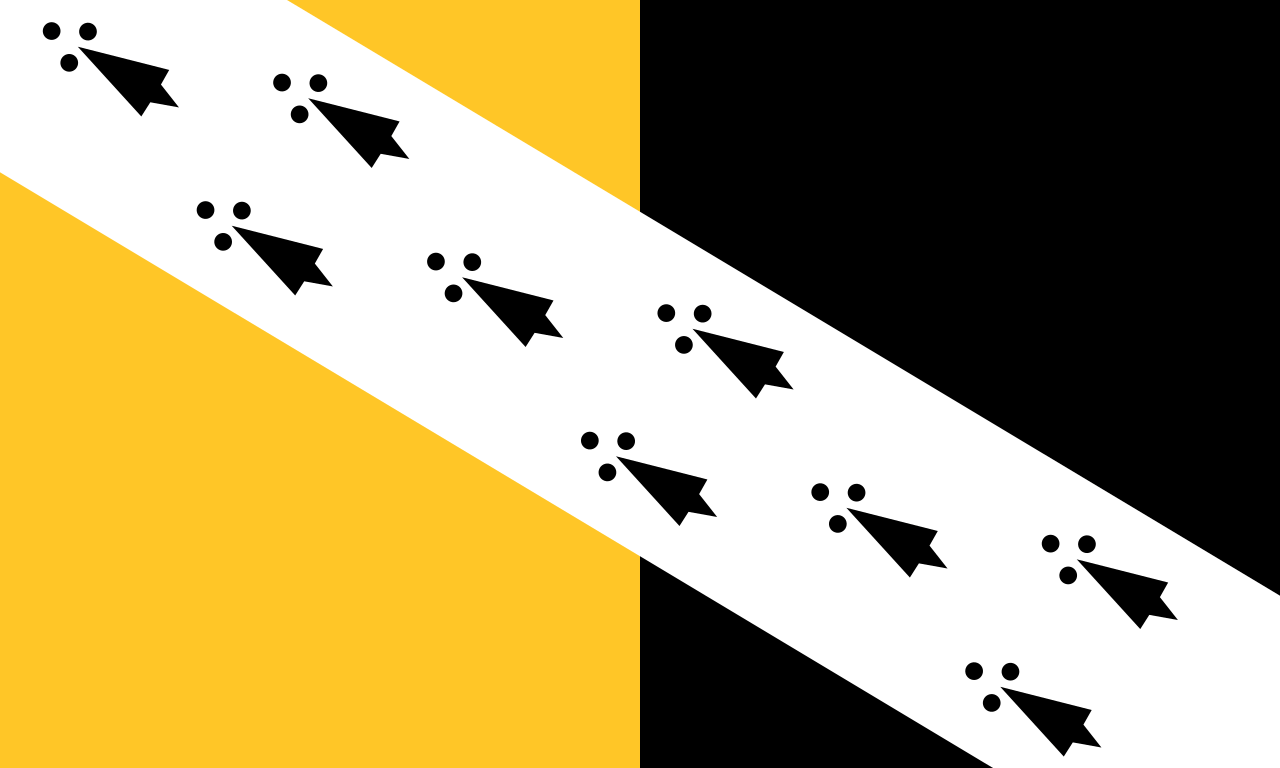
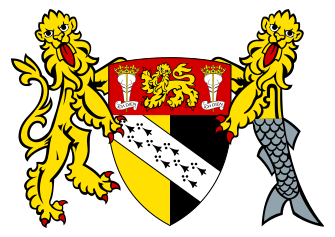
The flag of Norfolk is gold and black with a bend of ermine: the banner of the arms attributed to Ralph de Gael, Earl of Norfolk in the 11th century, registered as the county flag in 2014. The same design forms the arms of Norfolk County Council, granted in 1904 beneath a royal chief authorised by King Edward VII, to which a lion for Norwich and a half-lion, half-herring for Great Yarmouth were added as supporters in 1982.
Click on a country to learn more
| Flag | Per pale Or and Sable, a bend Ermine; proportion 3:5 |
|---|---|
| Origin of the flag | Arms attributed to Ralph de Gael, Earl of Norfolk c. 1069–1075 |
| Flag registered | Flag Institute, 11 September 2014 |
| Council arms | Royal Licence of Edward VII, 11 May 1904; granted 3 July 1904 |
| Supporters | Granted 22 December 1982: a lion for Norwich, a half-lion, half-herring for Great Yarmouth |
Flag of Norfolk — Per pale Or and Sable, a bend Ermine; registered in 2014.
Per pale Or and Sable, a bend Ermine.
The field is divided vertically, gold at the hoist and black at the fly, and crossed by a white bend from the upper hoist to the lower fly. Ermine is drawn in different ways; for the registration a precise pattern was chosen with the Flag Institute: nine black ermine spots, alternating between pairs and singles. The proportion is 3:5, and the gold is given as Pantone 123C.
The flag is the banner of the arms attributed to Ralph de Gael, also called de Guader, Earl of Norfolk from about 1069 until 1075 and Lord of Gaël in Brittany. He was the leading figure in the Revolt of the Earls in 1075 and forfeited his earldom. These arms were attributed to him later: he could not have borne them in his lifetime, since heraldry did not begin until about 1127. The ermine may refer to Brittany, where Ralph was Lord of Gaël: the dukes of Brittany bore a shield of plain ermine, and ermine figures in much Breton heraldry.
The arms of Ralph de Gael appeared on John Speed’s map of Norfolk in 1610, and later at a medieval pageant in 1929. They became the basis of the county council arms in 1904, and local organisations such as historical societies and sports clubs used the design, among them the Norfolk Broads Yacht Club. After a campaign by a Norfolk resident, Dominic Smith, the flag was standardised in consultation with the Flag Institute; the Association of British Counties commissioned a flag in this design and flew it on Historic County Flags Day, 23 July 2014. It was registered on 11 September 2014 as a traditional county flag.
Arms of Norfolk County Council — shield granted in 1904, supporters in 1982.
Per pale Or and Sable a Bend Ermine on a Chief Gules a Lion passant guardant of the first between two Ostrich Plumes Argent quilled and each ensigned with a Prince’s Coronet thereon the motto “Ich Dien” as borne on the Banner of King Edward III. Supporters: on either side a Lion guardant Or, that on the sinister dimidiating a Herring erect Argent.
On 2 January 1904 the County Council, established under the Local Government Act 1888, authorised Hamon le Strange to petition the College of Arms for a coat of arms, the cost to be paid by private subscription. A Royal Licence of King Edward VII, dated 11 May 1904, specifically instructed on the design of the arms to be granted “in commemoration of our long residence in Norfolk”: a reference to Sandringham, bought in 1862 as a country home for him, then Prince of Wales, and his future wife, Princess Alexandra. The arms were granted on 3 July 1904, and on 1 October Le Strange presented them to the Chairman of the Council with the Royal Warrant. They were unusual for a local authority in consisting only of a shield.
The chief shows a lion from the royal arms of England, with the ostrich plumes and coronet of the Prince of Wales, which the Council describes as a very special honour. The ostrich feathers are generally traced back to Edward the Black Prince, eldest son of King Edward III, who bore as his “shield for peace” Sable, three ostrich feathers Argent. The rest of the shield is the arms attributed to Ralph de Gael, the same design as the flag.
In June 1973 the new County Council created under the Local Government Act 1972 resolved to seek the transfer of the old Council’s shield, with supporters and a crest added; in 1974 it cancelled the request, then decided to seek supporters only. Because the former county boroughs of Norwich and Great Yarmouth were now part of the county, the College of Arms required some element of difference between the old arms and the new. The Council chose supporters representing the two boroughs: on the dexter a lion, taken from the arms of the City of Norwich, and on the sinister a lion joined to a herring, taken from the arms of Great Yarmouth, which are Per pale Gules and Azure three Lions passant guardant in pale Or dimidiated with as many Herrings naiant in pale Argent.
In July 1978 the College found that, through an oversight, the same supporters had been granted twelve months earlier to Stockton-on-Tees. The difficulty was lifted in February 1981, when it was noticed that the Stockton supporters had webbed extremities rather than claws. The supporters were granted on 22 December 1982. According to the Council, organisations other than the County Council may only use the Norfolk shield.
The arms of the county are not those of the peers who took its name. After Ralph de Gael, the Bigod family held the earldom from its creation of 1141 until the death of Roger Bigod, 5th Earl, in 1306. The first Duke of Norfolk was Thomas de Mowbray, in 1397; in 1483 Richard III created John Howard Duke of Norfolk, and the title has remained with his descendants, apart from periods of forfeiture. The Duke is the premier duke and earl in the English peerage.
The Howard arms are Gules, a bend between six cross crosslets fitchy Argent. On the bend, an augmentation of honour granted by Henry VIII to the 2nd Duke for the victory at Flodden: an escutcheon Or with a demi-lion rampant pierced through the mouth by an arrow, within a double tressure flory counterflory Gules, a modification of the royal arms of Scotland.
Since 1672 the office of Earl Marshal has been hereditary in the Howard family. The Earl Marshal organises coronations and state funerals, helps organise the State Opening of Parliament, and has charge over the College of Arms: no coat of arms may be granted without his warrant.
A banner of gold and black divided vertically, with a white bend charged with black ermine spots: in heraldic terms, Per pale Or and Sable, a bend Ermine. It is the banner of the arms attributed to Ralph de Gael, Earl of Norfolk in the 11th century, and was registered with the Flag Institute as the county flag on 11 September 2014.
Ralph de Gael, or de Guader, was Earl of Norfolk from about 1069 until 1075 and Lord of Gaël in Brittany. He was the leading figure in the Revolt of the Earls in 1075 and forfeited his earldom. The arms associated with him were attributed to him later, since heraldry did not yet exist in his lifetime.
The shield was granted on 3 July 1904, following a Royal Licence of King Edward VII dated 11 May 1904. The supporters, a lion and a half-lion, half-herring, were granted on 22 December 1982.
King Edward VII authorised the lion and the plumes of the chief “in commemoration of our long residence in Norfolk”, a reference to Sandringham, bought for him in 1862 when he was Prince of Wales. The plumes with the coronet and the motto Ich Dien are the badge of the Prince of Wales.
The supporters were added in 1982, after the former county boroughs of Norwich and Great Yarmouth had become part of the county. The lion comes from the arms of Norwich; the lion joined to a herring comes from the arms of Great Yarmouth, where three lions are dimidiated with three herrings.
No. The county council bears the arms attributed to Ralph de Gael with a royal chief. The Dukes of Norfolk, of the Howard family, bear Gules, a bend between six cross crosslets fitchy Argent, with the augmentation granted for the battle of Flodden.
Illustrations: Wikimedia Commons, public domain.
Last reviewed by the Emblema Mundi editorial team on 4 October 2026.