County · North West England
Lancashire carries the most famous flower in English history: the Red Rose of Lancaster, here set on a field of gold. It is the badge of the House of Lancaster, worn against the white rose of York in the Wars of the Roses, and the enduring emblem of the “Red Rose County.” The two roses were finally joined, after the wars, in the red-and-white Tudor Rose — but in Lancashire the rose stays defiantly red.
Click on a country to learn more
| Country | England (United Kingdom) |
|---|---|
| Region | North West England |
| County town | Lancaster (administrative centre: Preston) |
| Nickname | The Red Rose County |
| Emblem | The Red Rose of Lancaster |
| Flag registered | 20 November 2008 (Flag Institute) |
| Lancashire Day | 27 November |
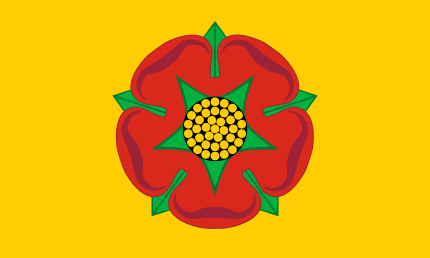
Flag of Lancashire — the Red Rose of Lancaster on a gold field
The flag is a single Red Rose of Lancaster on a gold field, at a ratio of 3:5. The rose is drawn as a heraldic rose — five petals with green barbs and a gold centre — in Pantone 485 C red on a Pantone 116 C gold ground. It was designed by the Friends of Real Lancashire and registered with the Flag Institute on 20 November 2008.
The gold field is a modern necessity rather than an ancient choice. The red rose had traditionally been shown on white, but that design could not be registered as Lancashire’s flag: a red rose on white was already on the registry as the flag of Montrose in Scotland. Placing the rose on gold gave Lancashire a distinct banner of its own. It is flown each Lancashire Day, 27 November, from County Hall in Preston and other public buildings.
The red rose was the heraldic badge of the House of Lancaster, the branch of the Plantagenet dynasty that contested the English crown with the House of York and its white rose. Its ancestor is the gold rose badge of Edward I; his son Edmund Crouchback, Earl of Lancaster, is credited with adopting the rose in red, and it passed to the Lancastrian line.
The rose gave its name to the Wars of the Roses (1455–1487), the dynastic struggle between Lancaster and York. In truth the red rose owed much of its later fame to Henry VII: after defeating Richard III he married Elizabeth of York and fused the two flowers into the red-and-white Tudor Rose, a symbol of reconciliation. The plain red rose lived on as the emblem of Lancashire — the enduring rival of Yorkshire’s white.
The arms of Lancashire County Council were granted on 31 August 1903 (the supporters following on 26 October 1903). They set the county’s red roses on a red shield divided by three gold wedges.
Blazon: Gules, three piles — two issuant from the chief and one in base — Or, each charged with a rose of the field barbed and seeded proper. Crest: a lion passant guardant charged with a mascle gules, resting a forepaw on an escutcheon of the arms. Supporters: two lions, each gorged with a collar vair and bearing a pendent escutcheon of the rose. Motto: In consilio consilium (“In council is wisdom”).
The three golden piles — wedge shapes driven into the shield — each carry a red rose, multiplying the county’s emblem across the field. The lions of the crest and supporters recall the royal duchy of Lancaster, one of the great palatine lordships of medieval England.
The flag of Lancashire is the Red Rose of Lancaster on a gold field. It was registered with the Flag Institute on 20 November 2008, and it carries the red rose that has been the emblem of the county for centuries.
The red rose was traditionally shown on a white field, but that design could not be registered because a red rose on white was already registered as the flag of Montrose in Scotland. The county flag therefore places the Red Rose of Lancaster on a gold field.
The Red Rose of Lancaster is the badge of the House of Lancaster. It derives from the gold rose badge of Edward I and was adopted in red by his son Edmund Crouchback, Earl of Lancaster. It became the Lancastrian emblem in the Wars of the Roses.
Lancashire’s emblem is the red rose of the House of Lancaster; Yorkshire’s is the white rose of the House of York. The two houses fought the Wars of the Roses (1455–1487), and after his victory Henry VII fused them into the red-and-white Tudor Rose.
Lancashire Day is celebrated on 27 November, when the red-rose flag is flown from County Hall in Preston and other public buildings across the historic county.
Last reviewed by the Emblema Mundi editorial team on September 20, 2026.