County · South East England
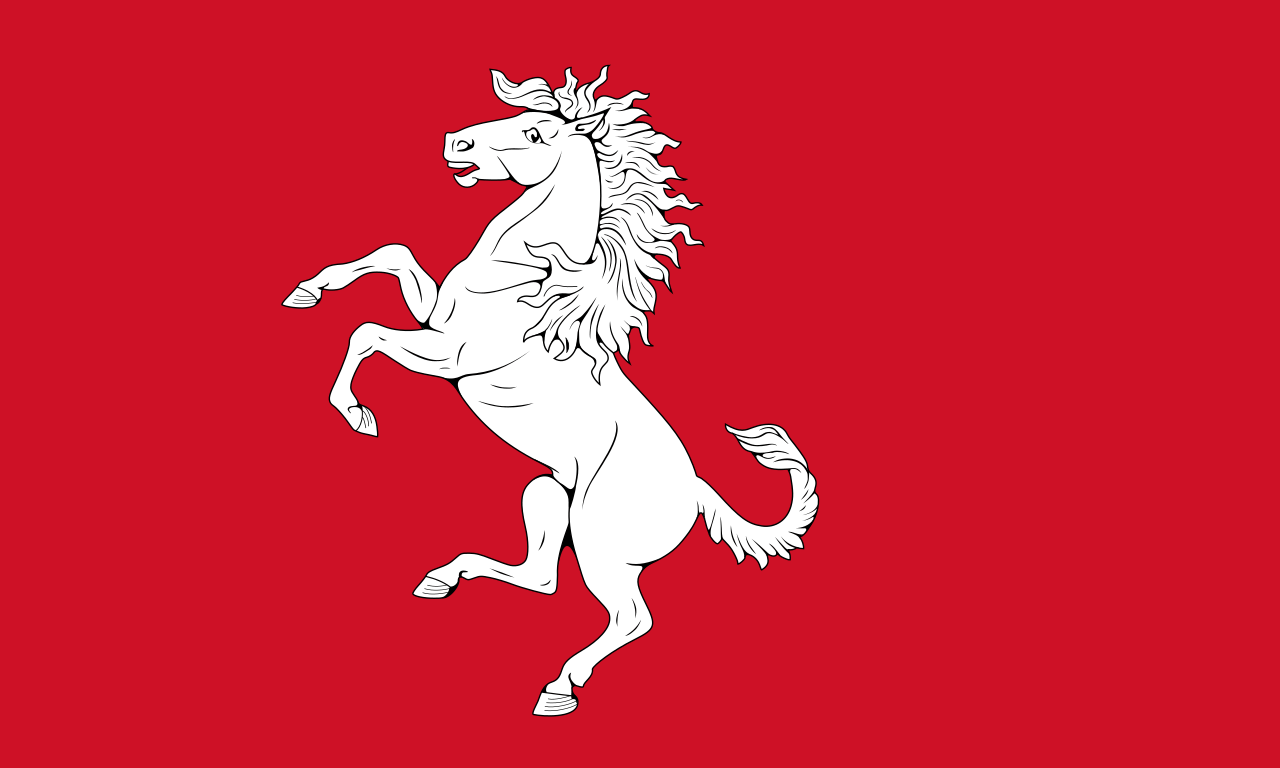
Kent flies one of England’s oldest emblems: a white horse rearing on a red field, blazoned Gules, a horse rampant argent. Known as the Invicta Flag, it carries the White Horse of Kent — a symbol traced variously to the Jutes of Hengist and Horsa, to pre-Roman British coins, and to the Saxon Steed of continental heraldry. Beneath it runs the county’s proud motto, Invicta, “unconquered.”
Click on a country to learn more
| Country | England (United Kingdom) |
|---|---|
| Region | South East England |
| County town | Maidstone |
| Nickname | The Garden of England |
| Emblem | The White Horse of Kent (Invicta) |
| Motto | Invicta (“unconquered”) |
| Arms granted | 17 October 1933 (Kent County Council) |
Flag of Kent — the white horse Invicta on a red field
The flag is a single white horse rearing on a red field — in heraldic terms Gules, a horse rampant argent. It is flown at a ratio of 3:5, the red usually given as Pantone 186 C. Because of the county’s motto it is often called the Invicta Flag.
The white horse as an emblem of Kent is old: the earliest printed record is Richard Verstegan’s A Restitution of Decayed Intelligence of 1605, which describes Kent’s banner as a horse. The device spread widely from the mid-eighteenth century and came into use as a flag in the nineteenth. After Kent County Council was granted arms bearing the horse in 1933, the Flag Institute accepted the white-horse banner as the flag of the historic county.
Where the horse comes from is genuinely disputed. The best-known tradition ties it to the Jutes, the post-Roman settlers from what is now Denmark whose leaders were remembered as the brothers Hengist and Horsa — names that in Old English mean “stallion” and “horse.” By legend they raised a white-horse banner over the first English kingdom of Kent.
Other explanations look elsewhere. Some trace the horse to pre-Roman British coinage, notably the coins of Dubnovellaunus of the Cantiaci, the Iron-Age tribe that gave Kent its name. Others connect it to the Saxon Steed (Sachsenross), the white horse of continental Germanic heraldry still borne by the former Electorate of Hanover and by modern Lower Saxony. Whatever its true source, the horse has served as the emblem of Kent for centuries.
The formal arms of Kent County Council, granted on 17 October 1933 and reconfirmed to its successor in 1975, carry the county’s emblem on the shield: Gules, a horse forcene argent — the same rearing white horse on red.
Blazon: Gules, a horse forcene argent. Crest: three ships’ masts with rigged courses and furled topsails, each flying a pennon charged with a red cross. Supporters: two sea lions, each collared gules with a pendent escutcheon — the See of Canterbury (dexter) and the Cinque Ports (sinister). Motto: INVICTA.
The maritime elements — the masts and the sea lions — speak to Kent’s long coastline and naval history, while the escutcheons honour Canterbury, seat of the English Church, and the Cinque Ports, the medieval confederation of Channel harbours. Over it all stands Invicta, “unconquered.”
The flag of Kent is a white horse rearing on a red field, blazoned Gules, a horse rampant argent. The white horse is the traditional emblem of the historic county, and the flag is recognised by the Flag Institute as the flag of Kent.
Invicta is Latin for “unconquered” or “undefeated.” It is Kent’s motto and reflects the county’s long-standing tradition of never having been truly subdued.
The white horse has stood for Kent for centuries. Its origin is debated: it is linked to the Jutish leaders Hengist and Horsa (whose names mean stallion and horse), to the horse on pre-Roman coins of the Cantiaci, and to the Saxon Steed of Germanic heraldry also seen in Hanover and Lower Saxony.
The flag shows the plain white horse on red. The full heraldic achievement of Kent County Council, granted in 1933, adds a crest of three ships’ masts, supporters in the form of sea lions bearing the shields of Canterbury and the Cinque Ports, and the motto INVICTA.
The Garden of England is a long-standing nickname for Kent, earned by its orchards, hop gardens and market gardens. It is only a nickname, though: the county’s heraldic emblem is the white horse.
Last reviewed by the Emblema Mundi editorial team on September 20, 2026.