Ceremonial county of England · Celtic nation
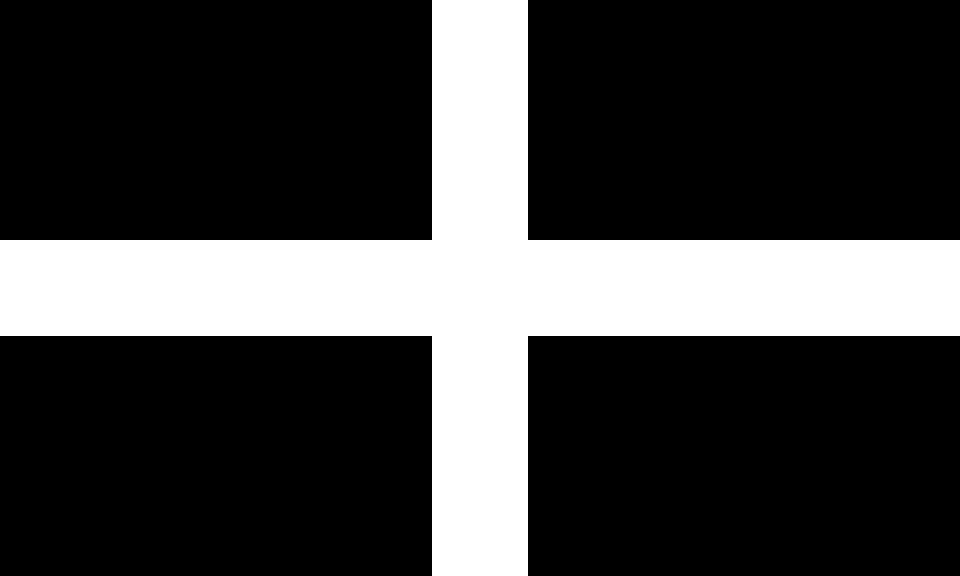
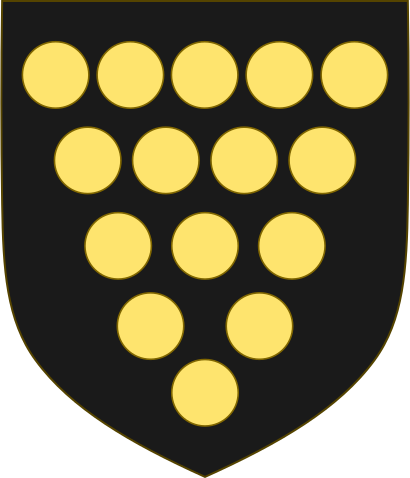
The flag of Cornwall (Cornish: Kernow) is Saint Piran’s Flag, a white cross on a black field. It is named after Saint Piran, the patron saint of tin miners, and its earliest known description, in 1838, sees in its colours “probably” an allusion to the black ore and the white metal of tin. Cornwall’s other emblem is the fifteen gold bezants on black of the Duchy of Cornwall, after the arms of Richard, Earl of Cornwall.
Click on a country to learn more
| Flag | Saint Piran’s Flag (Baner Peran): Sable, a cross Argent, 3:5 |
|---|---|
| Earliest known description | Davies Gilbert, The Parochial History of Cornwall, 1838 |
| Named after | Saint Piran, 5th-century abbot, patron of tin miners |
| National day | Saint Piran’s Day, 5 March |
| Arms | Sable, fifteen bezants (Duchy of Cornwall) |
Saint Piran’s Flag — Sable, a cross Argent; earliest known description, 1838.
Sable, a cross Argent.
A white cross on a black background, in the proportion 3:5. In Cornish it is called Baner Peran or An Gwynn ha Du.
The earliest known description of the flag was written by Davies Gilbert in The Parochial History of Cornwall (1838): “a white cross on a black ground [that] was formerly the banner of St Perran and the Standard of Cornwall; probably with some allusion to the black ore and the white metal of tin.” By “formerly” Gilbert implies an older use, but he left no record of his research and referred only to his recollection. One of the oldest depictions is in Westminster Abbey: a stained-glass window unveiled in 1888 in memory of the engineer Richard Trevithick shows Saint Piran carrying the banner of Cornwall, his head apparently a portrait of Trevithick himself.
Piran (Cornish Peran) was a 5th-century abbot who died around 480, possibly of Irish origin: scholars consider his Life a copy of that of the Irish saint Ciarán of Saigir. He is the patron saint of tin miners and is generally regarded as the patron saint of Cornwall, although Michael and Petroc also have some claim to the title. Legend says he “rediscovered” tin smelting when the tin in his black hearthstone, a slab of tin-bearing ore, was smelted out and rose to the top in the form of a white cross: the image on the flag.
Saint Piran’s Flag is the negative image of the old Breton flag, a black cross on white, and the flag of Saint David shares its black field under a gold cross. The Saint-Peran family of Cornouaille in Brittany bore a white cross pattée on black, recorded from the 15th century. It has also been suggested that the flag comes from the arms of the Earl or Duchy of Cornwall, from those of other Cornish families, or from the black and white livery of the Knights of St John. The story that it flew at Agincourt in 1415 seems to come from a confusion with Michael Drayton’s Poly-Olbion, which says the banner of the Cornishmen there showed two Cornish wrestlers.
Saint Piran’s Day (Gool Peran), on 5 March, is the national day of Cornwall; the week before is known as Perrantide. The flag flies from Cornwall Council buildings and at most Cornish gatherings, and is used around the world by the Cornish diaspora.
Arms of the Duchy of Cornwall — Sable, fifteen bezants.
Sable, fifteen bezants, five, four, three, two, one.
The bezants are gold. Adopted at an early period as a symbol of Cornwall, they appear frequently in Cornish heraldry. These arms, the arms of the Duke of Cornwall, were designed in the 15th century, based on the arms of Richard, Earl of Cornwall (1209–1272), who was also King of the Romans; his double-headed eagle probably explains why such eagles are common in Cornish arms and rare elsewhere in Britain.
The Duchy of Cornwall was established on 17 March 1337 by Edward III, out of the former Earldom of Cornwall, for his son Edward, the “Black Prince”, who became the first Duke of Cornwall.
A. Fox-Davies, in his Book of Public Arms, explains the bezants with a story: when King John wished to pledge his crown jewels, five Cornish pawnbrokers formed a company to take over his debts, and its trade-mark was fifteen balls with the motto “One and All”, because no business could be arranged without all five members. The motto of Cornwall Council is the Cornish Onen hag Oll, “One and All”.
Cornwall is one of the six regions widely considered Celtic countries in modern times, with Brittany, Ireland, the Isle of Man, Scotland and Wales; see the Celtic nations. Its language, Cornish (Kernewek), is Brittonic like Breton and Welsh. It became extinct as a living community language by the end of the 18th century; a revival began in the early 20th century, and in 2010 UNESCO reclassified it as critically endangered.
In 2014 the UK Government recognised the Cornish people and afforded them protection under the Council of Europe’s Framework Convention for the Protection of National Minorities.
Saint Piran’s Flag is a white cross on a black field, named after Saint Piran, the patron saint of tin miners. Its earliest known description, by Davies Gilbert in 1838, sees in it “probably” an allusion to the black ore and the white metal of tin.
A 5th-century abbot who died around 480, possibly of Irish origin. He is the patron saint of tin miners and is generally regarded as the patron saint of Cornwall. Legend says he rediscovered tin smelting when a white cross of tin rose from his black hearthstone.
On 5 March. It is the national day of Cornwall, and the week before is known as Perrantide.
Saint Piran’s Flag is the negative image of the old Breton flag, a black cross on white. The Saint-Peran family of Cornouaille in Brittany also bore a white cross pattée on black, recorded from the 15th century. Its exact origin remains uncertain.
They are gold bezants: the arms of the Duke of Cornwall are Sable, fifteen bezants. These arms were designed in the 15th century, based on the arms of Richard, Earl of Cornwall (1209–1272).
On 17 March 1337, by Edward III, for his son Edward, the Black Prince, who became the first Duke of Cornwall.
Illustrations: Wikimedia Commons. Arms of the Duchy of Cornwall (CC BY-SA 3.0); flag: public domain.
Last reviewed by the Emblema Mundi editorial team on 4 October 2026.