Country
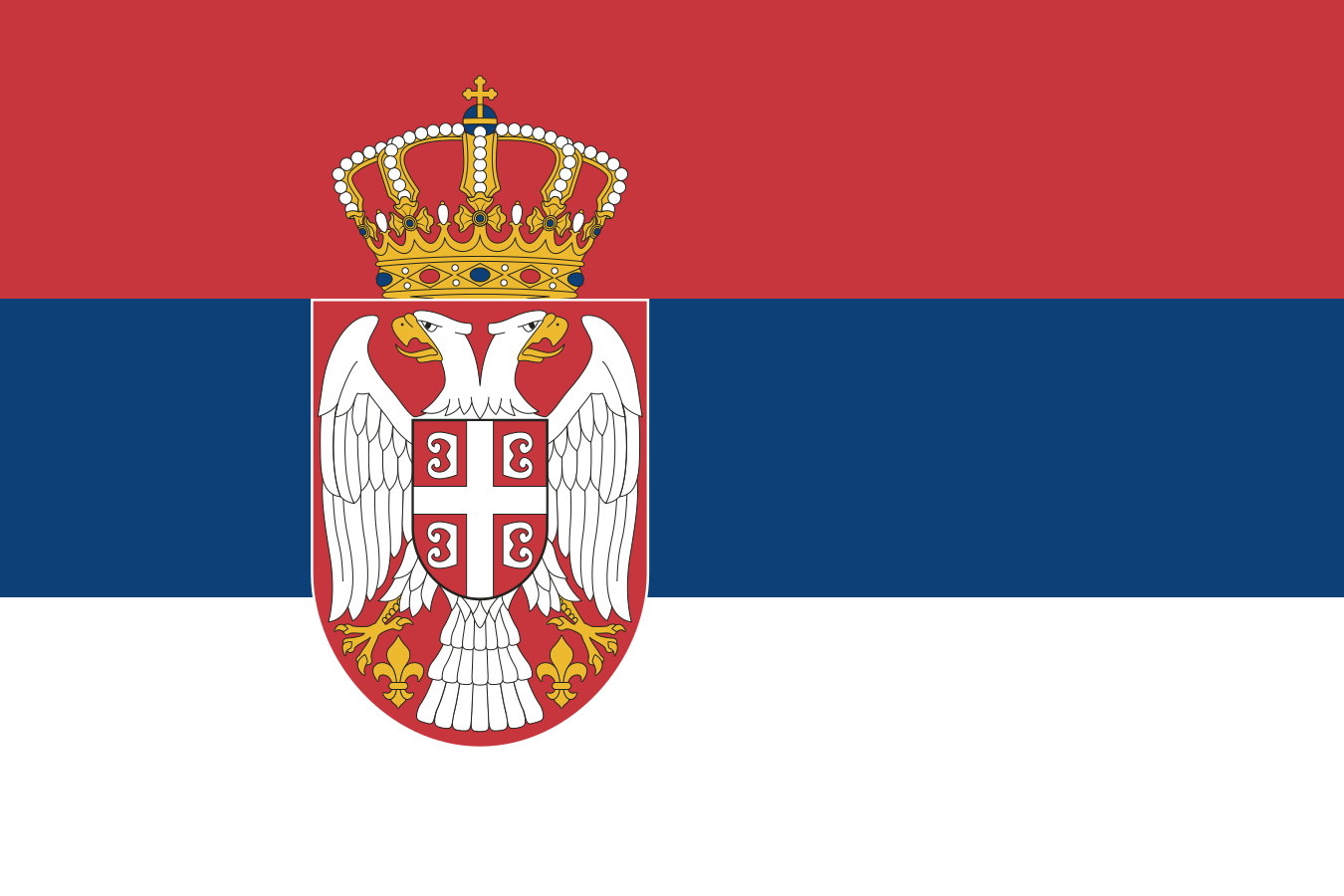
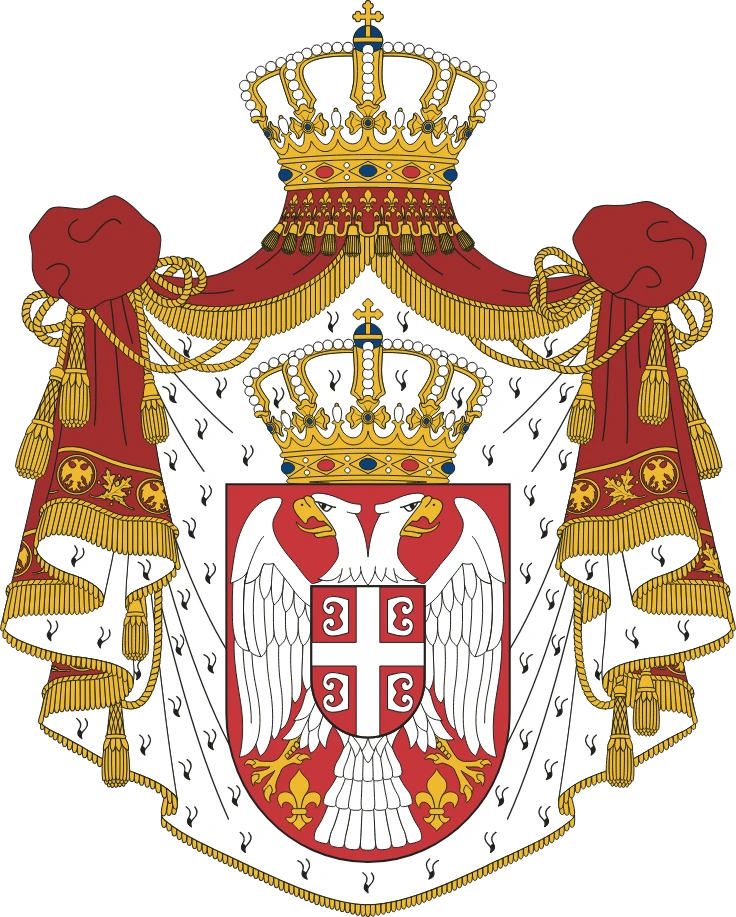
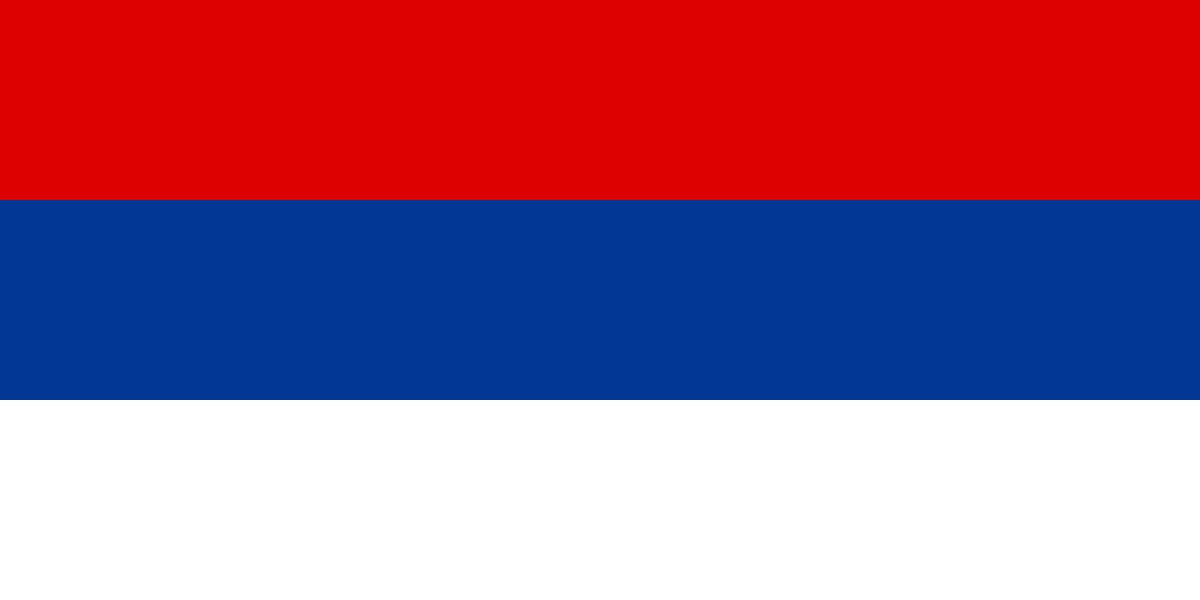
Serbia’s flag is the Russian tricolour upside down — and, by the traditional account, that is exactly how it was born: in 1835 Prince Miloš Obrenović proposed the Russian colours, and when the Russian consul objected, he reversed them. Its arms are far older — the silver double-headed eagle of the Nemanjić and the cross with four firesteels, a Byzantine monogram reread as Serbian. Both were restored in 2004 and redrawn in 2010.
Flag
Not available
Coat of Arms
Not available
| Flag | Red, blue and white; the state flag carries the lesser arms, the civil flag is plain |
|---|---|
| Tricolour | Since 1835–1839; current form 2004, standardised 2010 |
| Arms | A silver double-headed eagle on red, with the cross and four firesteels on its breast, crowned |
| Arms adopted | Kingdom of Serbia, 1882; readopted 2004, law of 2009, redrawn 2010 |
| Two forms | Greater arms (with mantle) and lesser arms (shield and crown) |
The flags of Serbia from the medieval kings to today — click the thumbnails.
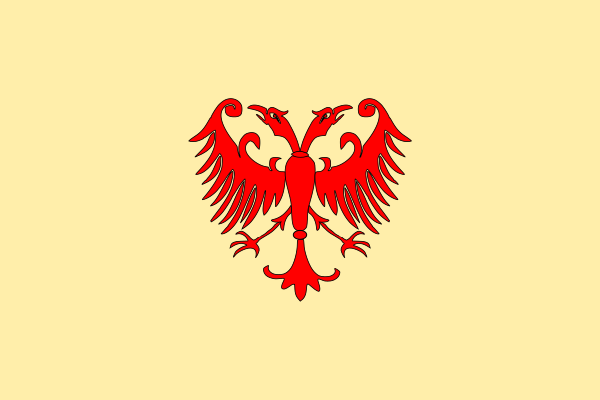
Medieval Serbia had no national flag, only the banners of its rulers. The later Nemanjić kings bore a red double-headed eagle on a yellow, sometimes white, field. In 1326 King Stefan Dečanski sent to the Mamluk Sultanate for a yellow war flag, and the oldest known drawing of a Serbian flag, on Angelino Dulcert’s chart of 1339, shows the red eagle on white. Stefan Dušan was crowned emperor in 1346.
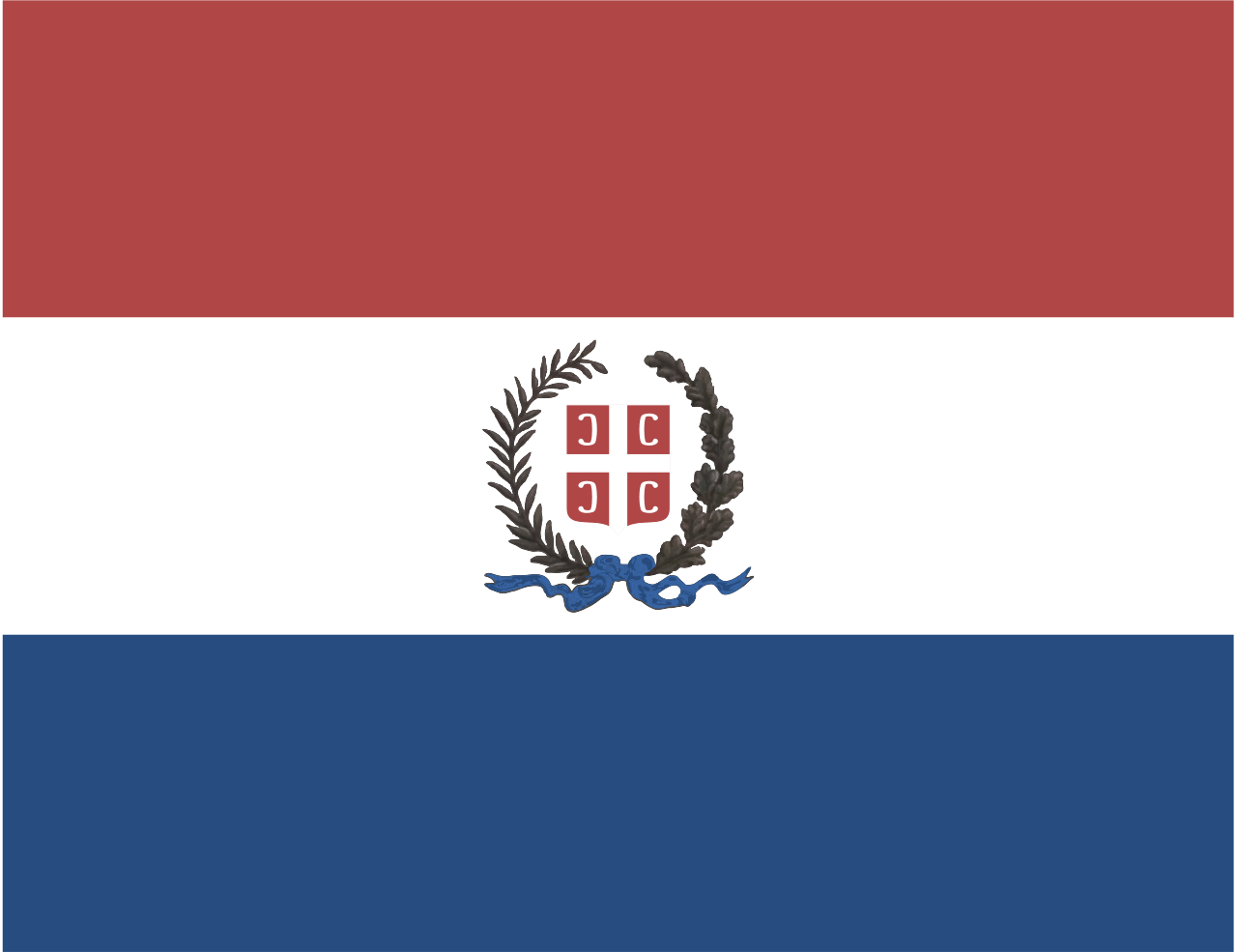
The constitution adopted at the Sretenje Assembly named the national colours as “red, white and steel-blue”. On 15 February 1835 Prince Miloš Obrenović and the deputies swore an oath beneath the new flag. Under pressure from Russia and the Ottoman Empire, the constitution was suspended within weeks and abolished on 11 April 1835 — and its flag with it.
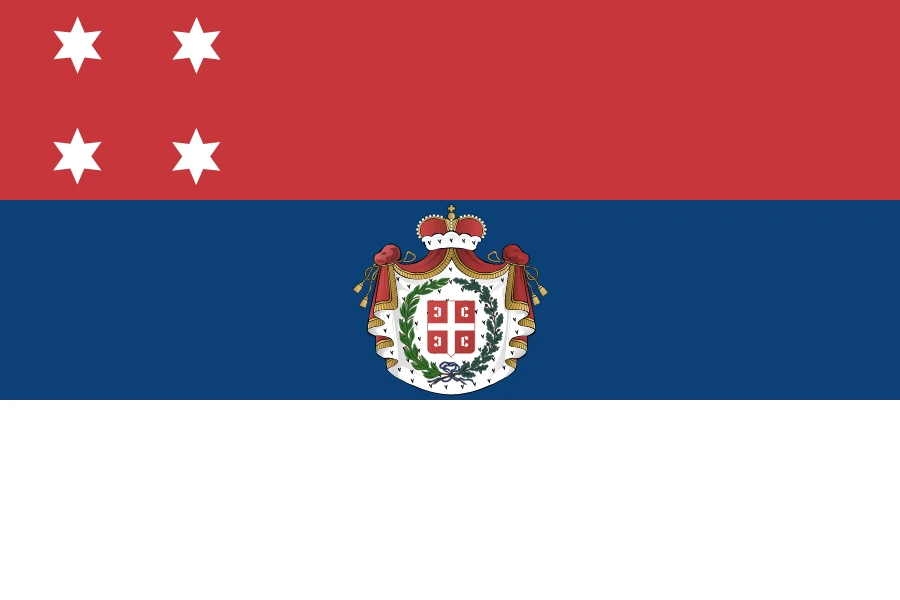
The Ottoman firman of January 1839 fixed the flag as “red above, blue in the middle, and white below”, with the arms of Serbia on the blue band. Four six-pointed stars in the upper-left corner of the red band marked the sultan’s sovereignty over the principality.
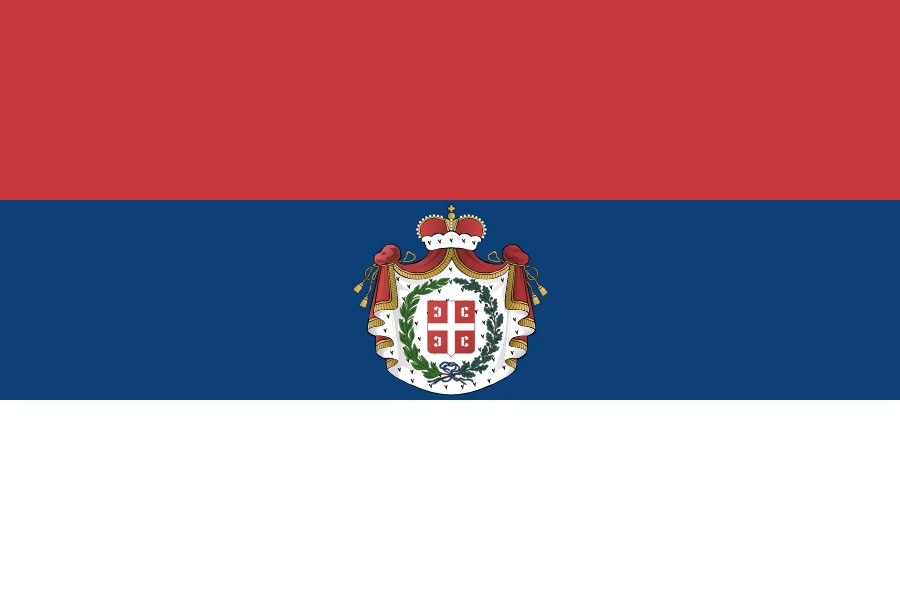
The Congress of Berlin recognised Serbia’s independence in 1878, and the four stars of Ottoman sovereignty came off the flag. Nothing else changed.
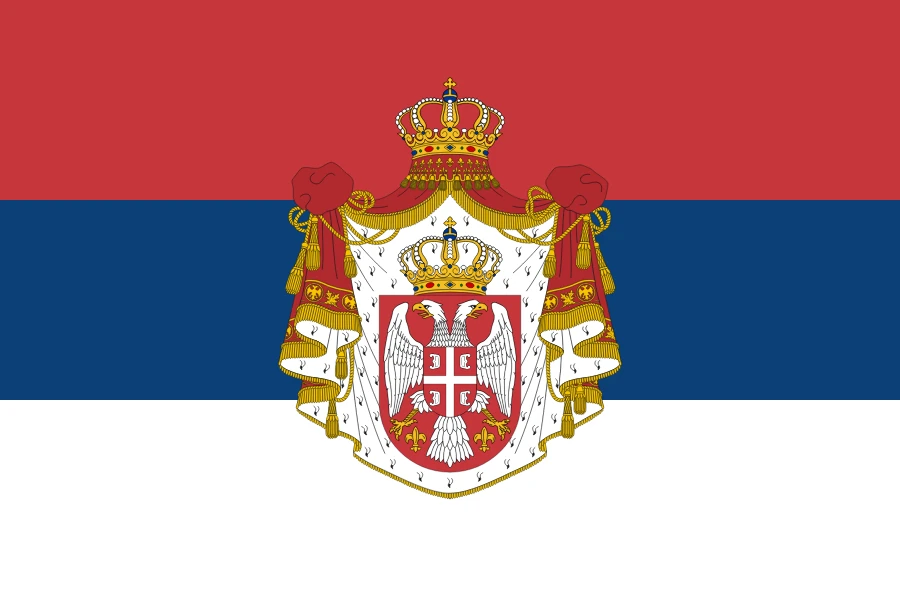
When the kingdom was proclaimed in 1882, the new royal arms — the white eagle on a red shield, crowned — went onto the state flag, and a plain tricolour became the civil flag.
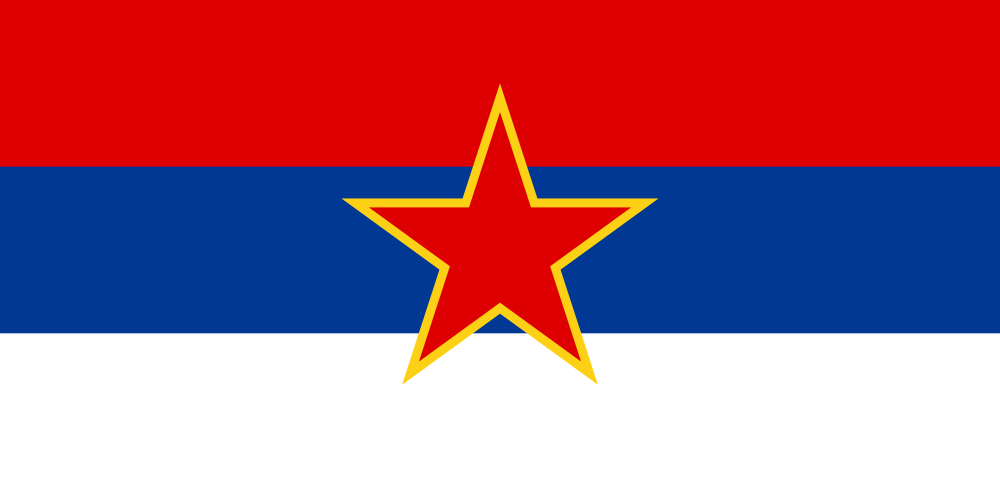
In socialist Yugoslavia each republic could choose its flag on one condition: it had to carry a red star. Serbia kept its red, blue and white tricolour and set the star in the centre.
A referendum in 1992 asked voters to choose between the flag with and without the star. The version without it won a majority of the votes, though not the absolute majority of registered voters the constitution required; the National Assembly removed the star anyway, by recommendation.
A parliamentary recommendation of 2004 brought back the two flags of the kingdom: the state flag with the lesser coat of arms, the civil flag without. The 2006 Constitution confirmed them, a law gave them full legal force in 2009, and in 2010 the colours were specified and the arms redrawn.
Medieval Serbia had no state flag in the modern sense: its banners were those of its ruling families. The oldest record of Serbian flag colours is an inventory. On 3 July 1281, envoys of Grand Prince Desa recovered at Dubrovnik part of the royal treasury left there by King Stefan Vladislav; among the items was vexillum unum de zendato rubeo et blavo — “a flag of red and blue silk”. The order of the colours is not known.
After the Sretenje Constitution fell in April 1835, Prince Miloš Obrenović kept pressing the Ottoman authorities for a flag of Serbia’s own. In Istanbul that year he first proposed the Russian white, blue and red — which the Russian consul took as a serious affront. Miloš is said to have replied: “Could we simply turn it upside down?” The reversed order, red, blue and white, was reportedly accepted by both the sultan and the consul. A firman of December 1835 allowed Serbian merchant ships to fly “a tricolour flag whose upper band is red, the middle band blue, and the lower band white”.
The Porte wanted four crescents on the flag as a sign of its sovereignty; Miloš negotiated six-pointed stars instead. They stayed until independence in 1878.
Since 1882, with an interruption under Yugoslavia, Serbia has used two flags. The state flag carries the lesser coat of arms, centred vertically and shifted towards the hoist by one-seventh of the flag’s length. The civil flag is the plain tricolour. Both are in proportion 2:3.
The arms and the flag of Serbia did not change at the same dates: each followed its own history. The arms are also older, and they lived on through four centuries when Serbia had no state at all.
The arms of Serbia from the medieval kingdom to today — click the thumbnails.
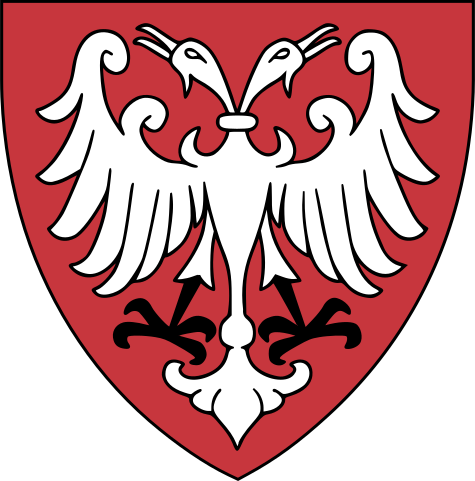
The medieval kingdom, proclaimed in 1217, bore a silver double-headed eagle on red — the colours Serbia carries again today. The eagle itself is older: the oldest preserved Nemanjić double-headed eagle is on the founder’s portrait of Miroslav of Hum, Stefan Nemanja’s brother, at Bijelo Polje, around 1190. It appears at Žiča (1207–1220), on a gold ring of Queen Teodora (1321–1322) and on Angelino Dulcert’s chart of 1339 — an emblem of the dynasty more than a coat of arms in the later sense.
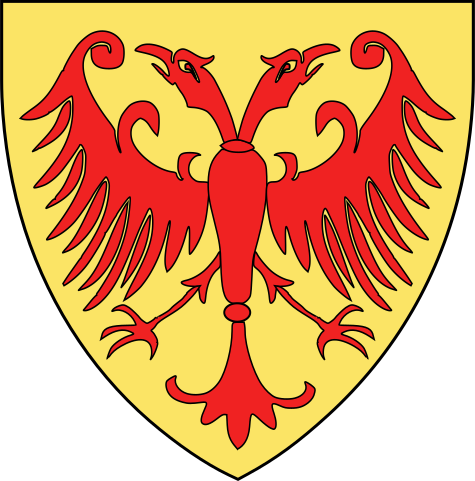
Under Stefan Dušan, crowned emperor in 1346, the colours were reversed: a red double-headed eagle on yellow.
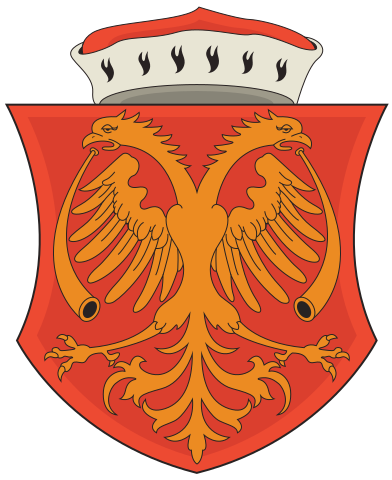
Stefan Lazarević received the title of despot from John VII Palaiologos in Constantinople in 1402, and the eagle became the official emblem. The Despotate’s arms show a golden double-headed eagle holding a silver horn in each beak — the symbol of the Hrebeljanović and Branković families who ruled it — on red, with a despot’s cap.
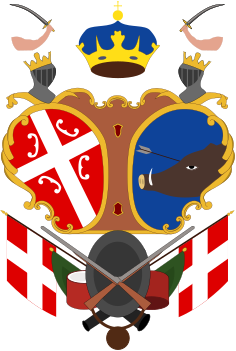
When Serbia rose against the Ottomans in 1804, the insurgent government put in its seal the two emblems the European armorials had kept alive: the Serbian cross and the boar’s head pierced by an arrow.
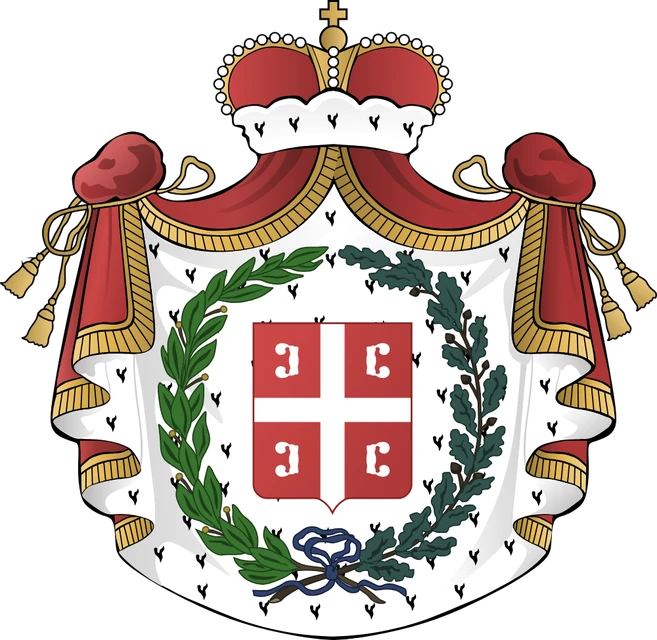
The autonomous Principality bore the cross alone: a white cross on red with four firesteels, between branches of olive and oak, on a princely mantle lined with ermine, under a princely crown. Prince Miloš Obrenović made it the official arms in 1838.
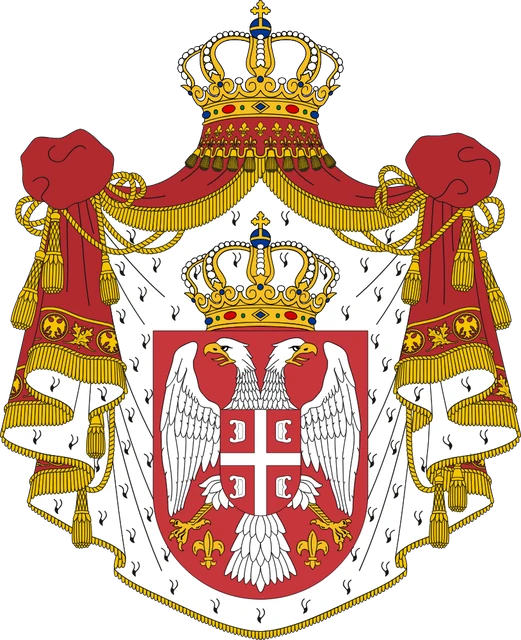
The kingdom proclaimed in 1882 joined the two medieval emblems in one achievement: the white double-headed eagle with the cross and firesteels on its breast, crowned, on a mantle lined with ermine. It is the model for the arms Serbia bears today.
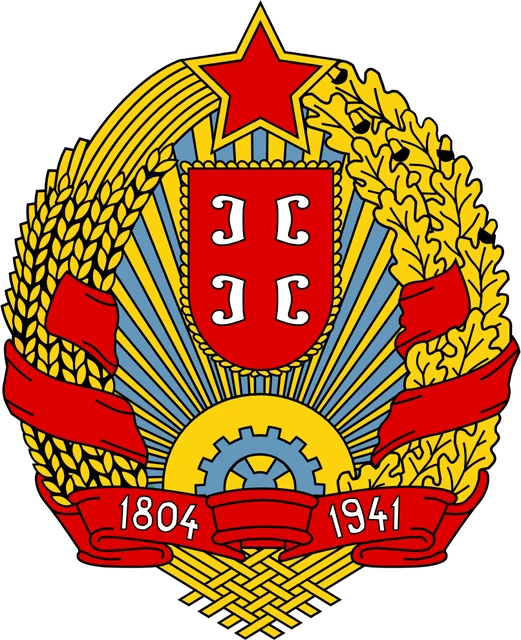
The socialist emblem kept the four firesteels but removed the cross, to marginalise religion. It set them above a rising sun and a cogwheel, in a wreath of wheat and oak, with a ribbon dated 1804 and 1941 — the First Serbian Uprising and the uprising against the Axis.
The arms of the kingdom came back in 2004, in a greater and a lesser form, and were redrawn in 2010. They are described below.
With the fall of the Despotate to the Ottomans in 1459, Serbia ceased to exist as a state for three and a half centuries, and with it any official arms. The arms survived elsewhere: in the Church, and in the armorials of Western and Central Europe. The Korenić-Neorić Armorial of 1595 gives Serbia a white cross over red and gold; armorials from the fifteenth to the eighteenth century often represent Serbia by the head of a boar pierced by an arrow, the so-called Triballian boar; and Pavao Ritter Vitezović’s Stemmatografia of 1701 spread the cross with four firesteels, which the Serbian Church then took up.
Coat of arms of Serbia — the greater arms, with the mantle, as redrawn in 2010.
Gules, between two fleurs-de-lis in base Or, a double-headed eagle displayed inverted Argent, armed, beaked and langued Or, surmounted by an escutcheon Gules thereon a cross between four firesteels Argent; the shield ensigned with a crown Or.
The Constitution provides for two forms. The greater arms add a red mantle fringed with gold, lined with ermine and crowned; they are used by the presidency, the government, the National Assembly, the highest courts, the National Bank — on dinar banknotes and coins — and by embassies. The lesser arms, the crowned shield alone, are far more common: on the state flag, on passports, identity cards and driving licences, and on police and customs uniforms.
The design is that of the Kingdom of Serbia of 1882, restored by a parliamentary recommendation in 2004, confirmed by law in 2009 and redrawn in 2010. A crown on the arms of a republic is unusual but not unique — Russia, Poland, Romania, Hungary, Bulgaria and Montenegro have one — but the mantle of the greater arms is a monarchical element the others do not carry.
The Serbian cross comes from Byzantium. It is based on the tetragrammic cross of the Palaiologos dynasty: a cross between four Greek letters beta. In Serbian use it is white on red rather than gold on red, and the four letters became ocila, firesteels — the curved steel strikers once used to make fire. The modern shapes still keep the straight side of a B.
When it became Serbian is debated: the historian Stanoje Stanojević dates it to 1345 and Dušan’s empire, Stojan Novaković to 1397 and Stefan Lazarević.
Since the nineteenth century, the four firesteels have popularly been read as four Cyrillic letters “С”, for the motto Samo sloga Srbina spasava — “Only unity saves the Serbs”. It is a folk etymology, laid over a Byzantine monogram, but it has become inseparable from the emblem.
Red, blue and white were fixed by Ottoman firmans of 1835 and 1839. According to the traditional account, Prince Miloš Obrenović first proposed the Russian white, blue and red, and when the Russian consul objected, he turned it upside down.
The state flag carries the lesser coat of arms and is used by state institutions; the civil flag is the plain red, blue and white tricolour. The distinction goes back to the Kingdom of Serbia in 1882 and was restored in 2004.
The double-headed eagle is a Byzantine symbol. The oldest preserved Nemanjić eagle dates from around 1190, on the portrait of Miroslav of Hum, Stefan Nemanja’s brother; it became the official emblem under Despot Stefan Lazarević in 1402.
Not as a state: from the fall of the Despotate in 1459 to the uprising of 1804, Serbia had no official arms. They survived in the Church and in European armorials, which gave Serbia the cross, or a boar’s head pierced by an arrow.
They are firesteels, ocila, derived from the four Greek letters beta of the Byzantine Palaiologan cross. Since the nineteenth century they have popularly been read as four Cyrillic C for Samo sloga Srbina spasava, Only unity saves the Serbs.
Two golden fleurs-de-lis, one under each claw of the eagle, have been in the arms since the law of 20 June 1882 that created the arms of the Kingdom of Serbia. Their designer, Stojan Novaković, wanted every element to rest on authentic medieval monuments, and the lily appears on the coins, regalia and frescoes of medieval Serbia; the oldest known Nemanjić eagle, around 1190, already has a lily-shaped tail.
The crown is the historical Serbian crown, kept from the arms of the Kingdom of Serbia of 1882. Several European republics, including Russia, Poland, Romania, Hungary and Bulgaria, also have crowns in their arms.
The flag and arms are described from the published descriptions and the texts above, not from the drawings.
Last reviewed by the Emblema Mundi editorial team on 1 October 2026.