Country
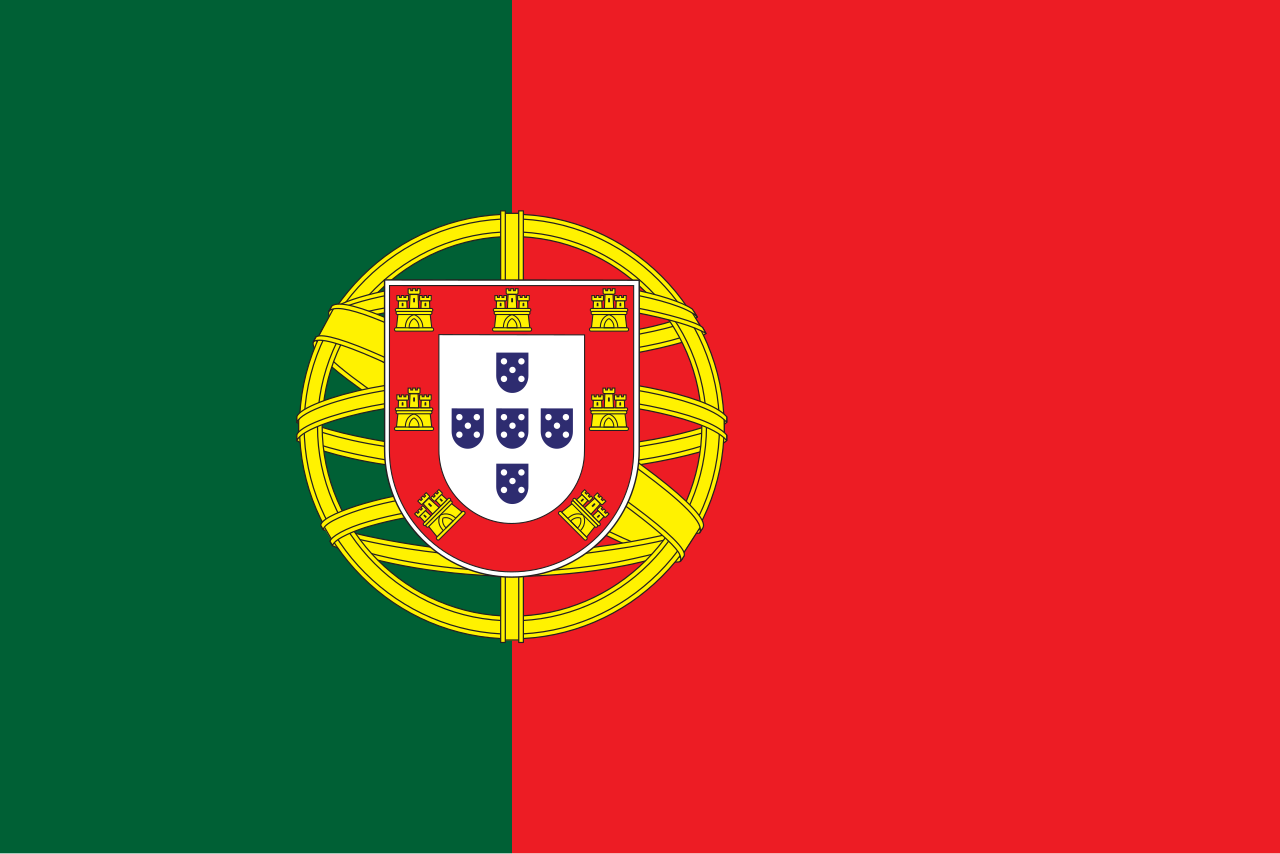
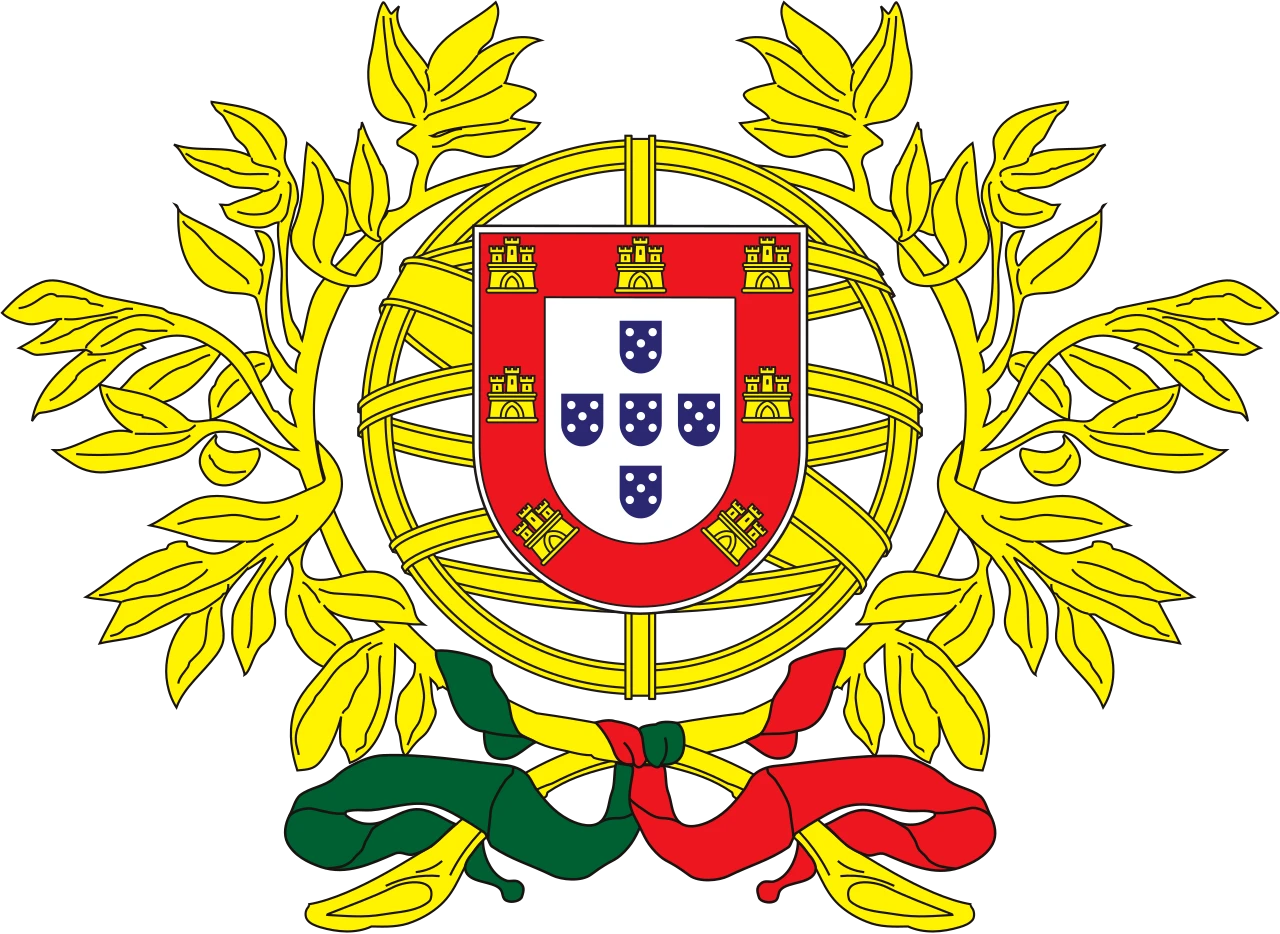
The flag of Portugal has been green and red since 1910, but the shield at its centre is far older: the five quinas, confirmed from the reign of D. Sancho I, the bordure of castles of D. Afonso III and the form fixed by D. João II in 1485. The armillary sphere, emblem of D. Manuel I, completes the arms of the Republic. This page follows the evolution of the flags and arms, from the medieval armorial banner to the flag of 1910.
Flag
Not available
Coat of Arms
Not available
| Flag | Divided green and red, with the arms on the armillary sphere |
|---|---|
| Shield | Argent, five quinas azure in cross; a bordure gules with seven castles Or |
| Armillary sphere | Emblem of D. Manuel I, in the arms since 1910 |
| Design | Columbano Bordalo Pinheiro, 1910 |
| Adopted | 1 December 1910; decree of 19 June 1911 |
The Portuguese flag went through three patterns: the armorial banner, which reproduced the shield itself, the white flag with the royal arms and, from 1830, a flag with colours of its own, first blue and white, then green and red. These are its stages, from D. Sancho I to the Republic.
Click the thumbnails to browse the flags.

1185
For centuries the flag of Portugal was an armorial banner: the cloth reproduced the field of the royal shield. The five blue quinas strewn with silver bezants on a silver field are only confirmed from the reign of D. Sancho I (1185-1211); the flanking escutcheons were then shown lying sideways, pointing to the centre one. Flags from before the 14th century are reconstructions, with no documents of the time to confirm them.
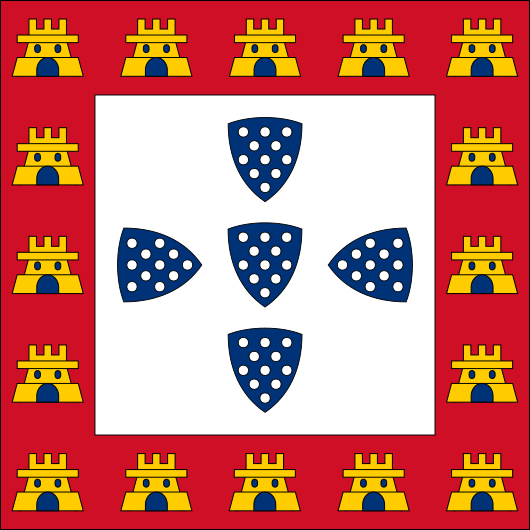
1248
When he came to the throne, D. Afonso III kept the arms he had borne as a younger prince: the quinas within a red bordure strewn with golden castles. Under the heraldic custom of the time, princes differenced the royal arms with elements from their mother’s arms, and the castles would come from D. Urraca de Castela. Tradition prefers to see them as the Algarve, whose reconquest D. Afonso III completed in 1249.
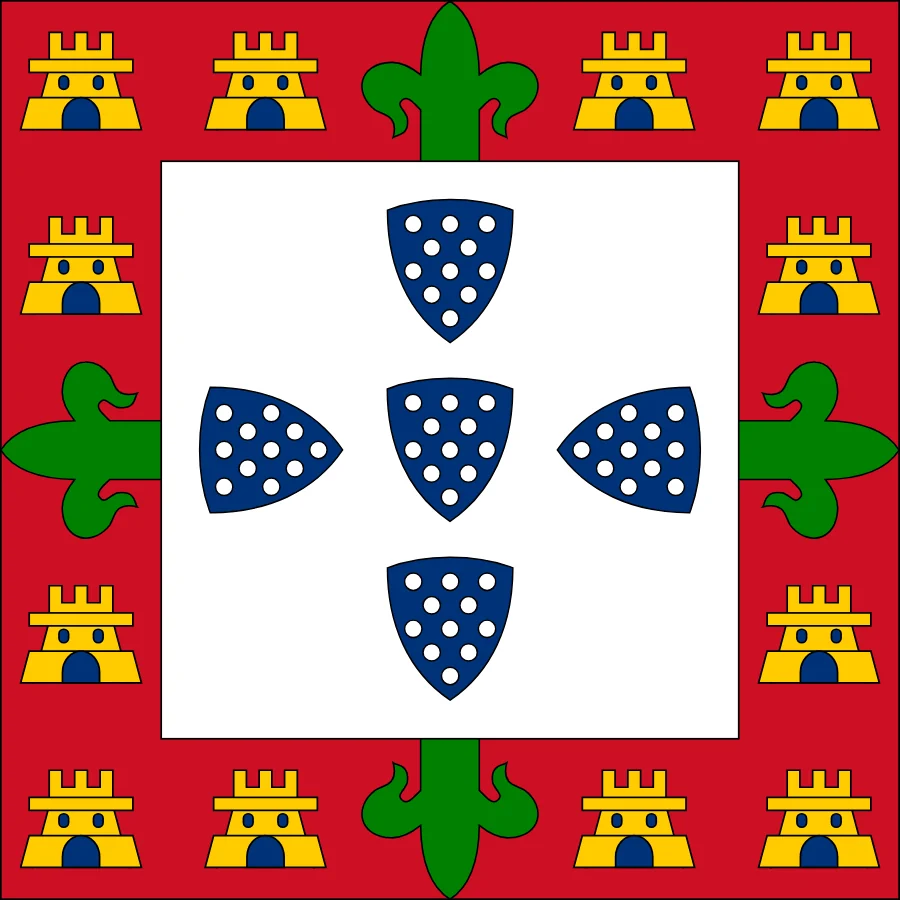
1385
D. João I, Master of the Order of Avis, kept the arms of the previous dynasty, a sign that they were already seen as the arms of the Kingdom rather than of the king alone. He added the cross of Avis, a green flowered cross; in its most common form its four fleur-de-lis ends sat in the bordure, between the castles. From 1385 to 1485, green was thus part of the arms and flag of Portugal.
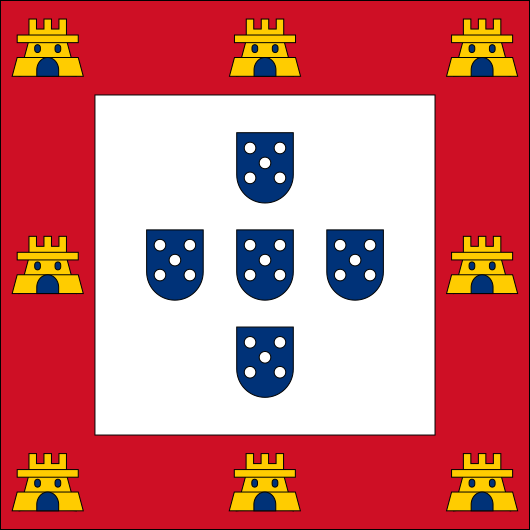
1485
In 1485, after a long debate, D. João II had the shield corrected according to the rules of good heraldry: the flanking quinas were set upright, because lying sideways they could be read as a mark of illegitimacy, and the cross of Avis was removed. The number of castles still varied, seven or eight; on banners there were mostly eight.
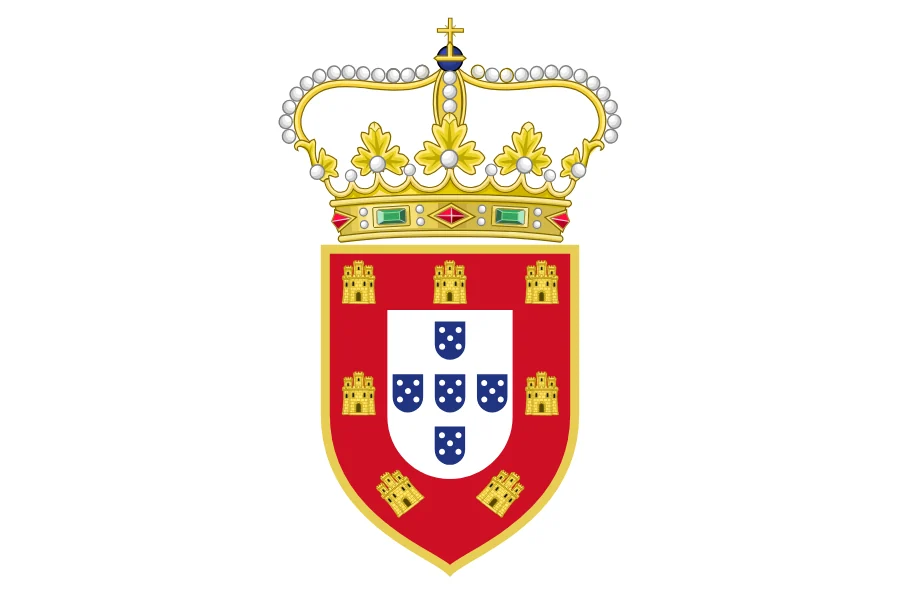
1578
At the end of the 16th century the flag stopped being a square copy of the shield: it now had a white field, the neutral colour par excellence, with the arms of Portugal in the centre, in the shield’s own outline and ensigned with the royal crown. The change follows the Renaissance taste for naturalistic depiction. During the Iberian Union (1580-1640), the plain arms of Portugal remained in use.
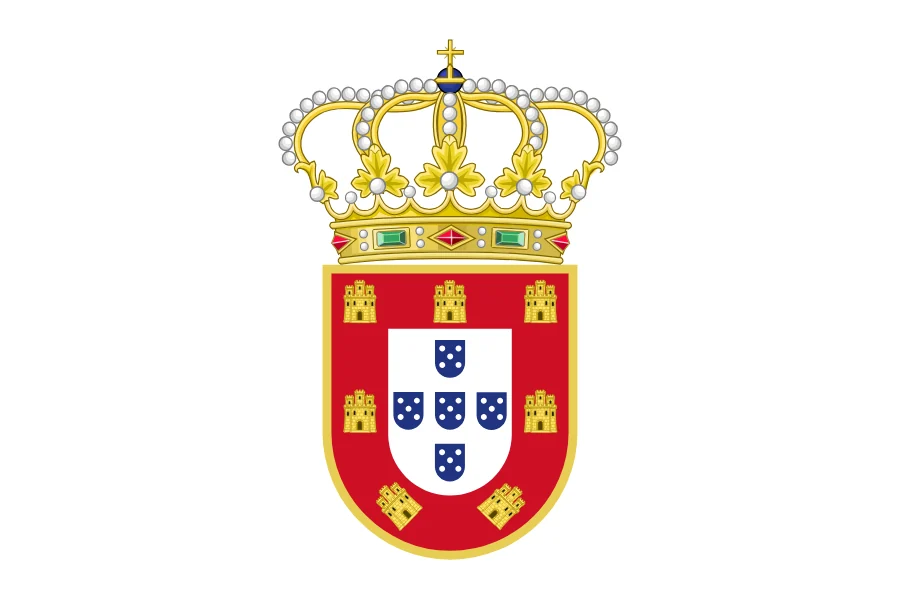
1667
The white-field design stayed; what changed was the crown. Closed with a single arch under D. Sebastião and with two in the 17th century, the royal crown received four arches under D. Pedro II, regent from 1667 and king from 1683 to 1706. The two-arched crown was left to the heir to the throne.
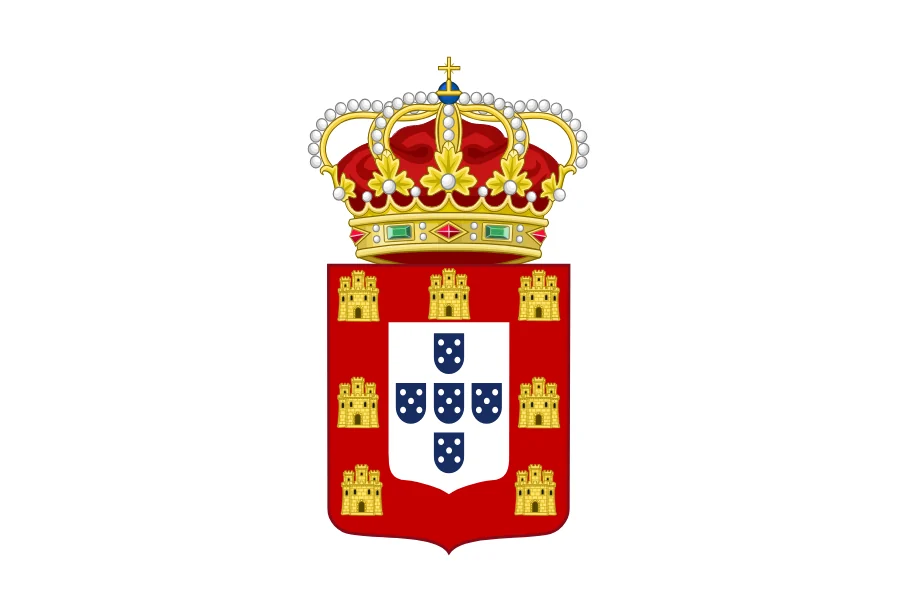
1707
Until the 19th century the arms on this flag kept the same marshalling; only the crown and the style of the shield changed with the fashion of each period. The flag with the royal arms was reserved for the king and the state, and private use was forbidden in 1692. Merchant ships flew the “flag of the Sphere”, also white but with an armillary sphere instead of the arms. At the end of the 18th century the restrictions eased and the flag of the royal arms became a true national flag.
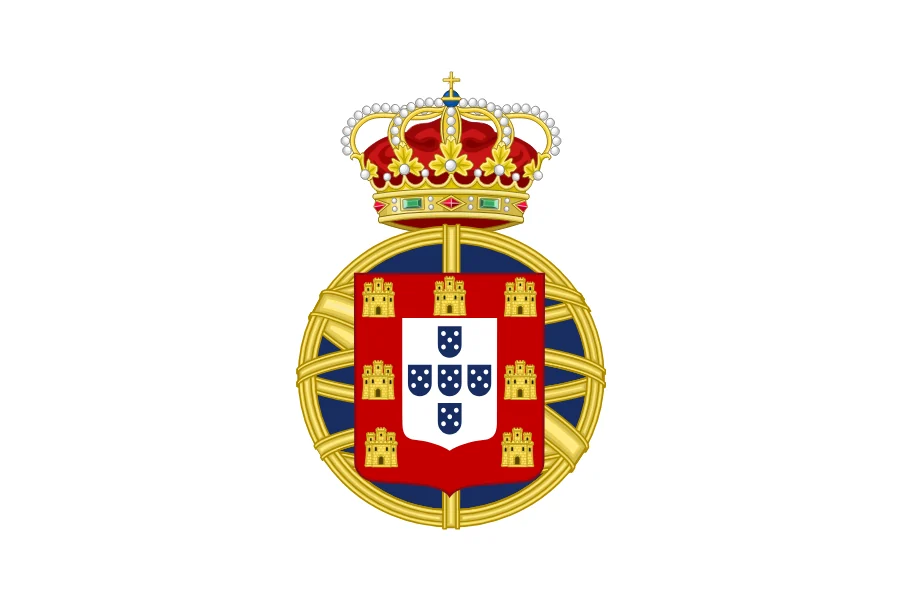
1816
With the creation of the United Kingdom of Portugal, Brazil and the Algarves, Brazil had to appear in the arms: the quinas already stood for Portugal and the bordure of castles for the Algarve. As the armillary sphere was used above all in Brazil, on the coins struck there, the arms of the Kingdom of Brazil became a golden armillary sphere on a blue field, and the shield of Portugal was set upon it. The flag kept its white field, now with these arms.
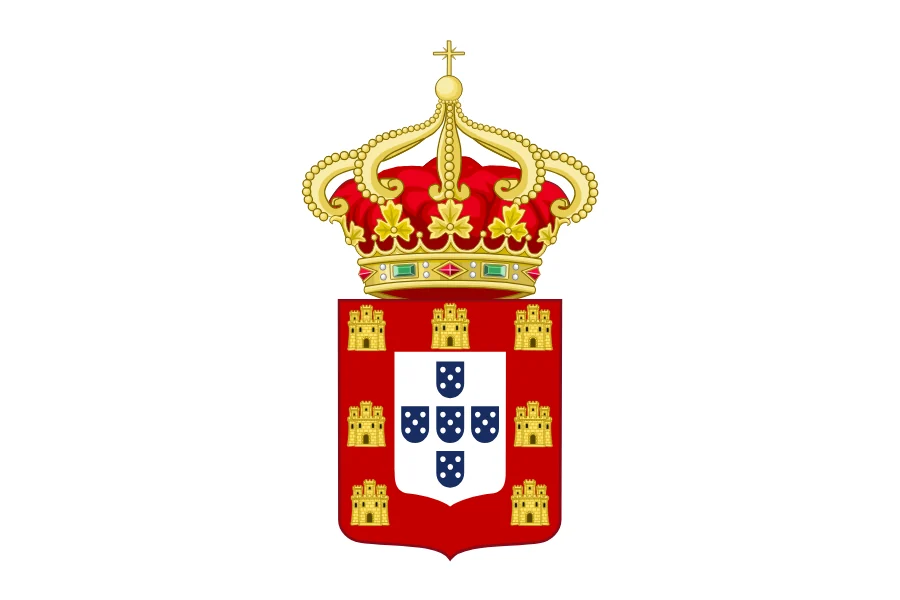
1826
After the death of D. João VI in 1826, the armillary sphere was removed and the arms returned to their earlier form. The white flag with the crowned royal arms remained in use until blue and white were adopted.
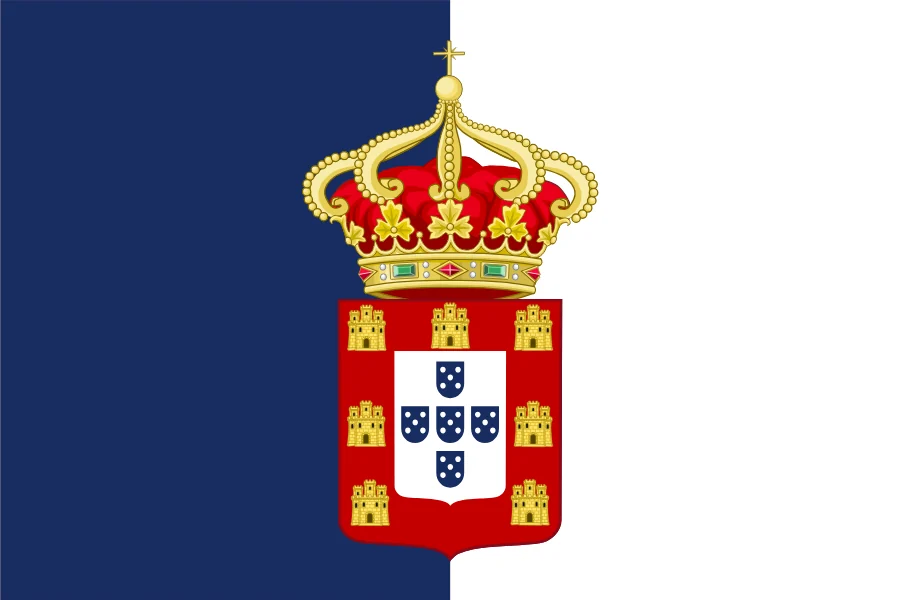
1830
In 1830 the field of the flag stopped being white and took on colours with a meaning of their own. The Cortes of 1820 rejected the livery colours of the Royal House as national colours and chose the proposal of deputy Francisco Trigoso, for whom blue and white had been the emblematic colours of the nation since its foundation: the blue of the escutcheons and the silver of the bezants of the quinas. The blue and white national cockade was approved in 1821; the flag, adopted by the Liberals in 1830, came into use across the whole country only after the end of the civil war, in 1834.
1910
Divided vertically, green at the hoist and red at the fly, the green taking two fifths of the length; in the centre, over the dividing line, the shield of Portugal edged in white, set on the Manueline armillary sphere. The design is by the painter Columbano Bordalo Pinheiro, a member of the commission appointed on 15 October 1910. Green and red were the colours of the republicans, already raised in the revolt of 31 January 1891; the commission’s report gave them no national meaning, but called red “the combative, warm, virile colour par excellence”. The flag was presented on 1 December 1910 and confirmed by the decree of 19 June 1911.
The shield of the quinas is the most constant element of Portuguese symbols. It took shape over some three centuries, between the 12th and the 16th, and since then only its external ornaments have changed: the crown, the supporters, the armillary sphere. These are its stages, from the shield of D. Sancho I to the arms of the Republic.
Click the thumbnails to browse the shields.
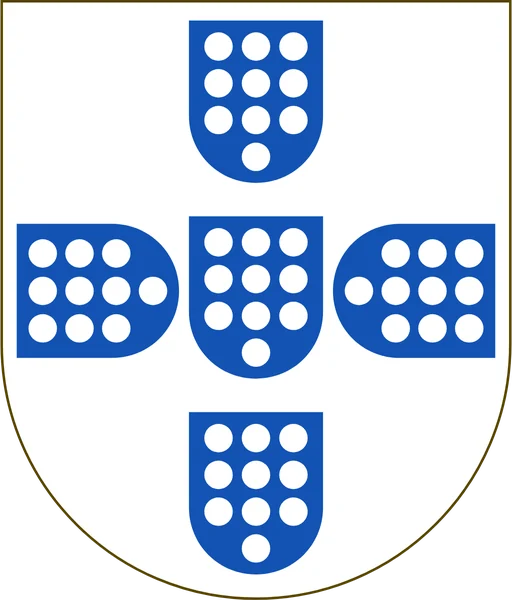
1185
Argent, five escutcheons in cross azure, semé of plates, the flanking escutcheons lying fesswise and pointing to the centre.
These are the first arms of Portugal whose existence is confirmed, struck on the morabitinos of D. Sancho I. Their origin is unknown. The oldest explanation, in the Crónica Geral de Espanha of D. Pedro Afonso, Count of Barcelos (1344), links them to the battle of Ourique: five shields for the five defeated Moorish kings, set in a cross, and in each the coins for which Judas sold Christ. Camões sees in the escutcheons the five wounds of Christ. A theory well accepted among heralds is more down to earth: the shield of D. Afonso Henriques bore a cross of blue leather strips nailed on; torn off in battle, five pieces and the nail heads would have remained.
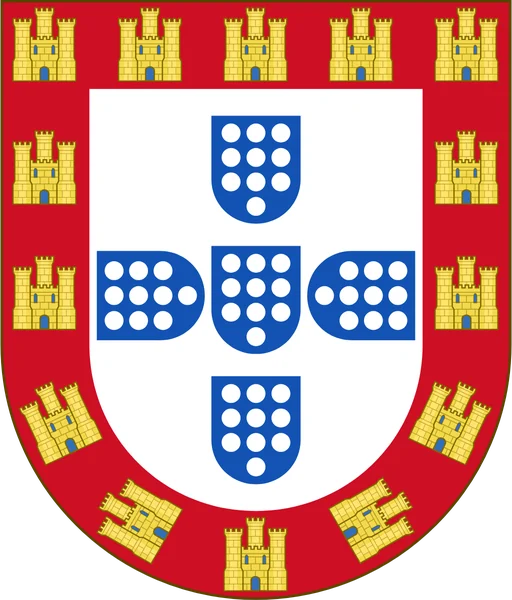
1248
Argent, five escutcheons in cross azure, semé of plates; a bordure gules semé of castles Or.
The bordure was a mark of difference: as a younger prince, D. Afonso III could not bear the full arms, reserved for his brother the king, and added the golden castles on red from the arms of his mother, D. Urraca de Castela. As king, he kept them. The shield without the bordure, the “ancient shield of Portugal”, came to mark the illegitimate children of the kings. Under D. Dinis the bezants were fixed at five per escutcheon, in saltire, and the escutcheons took the popular name of quinas, after the five face of a die.
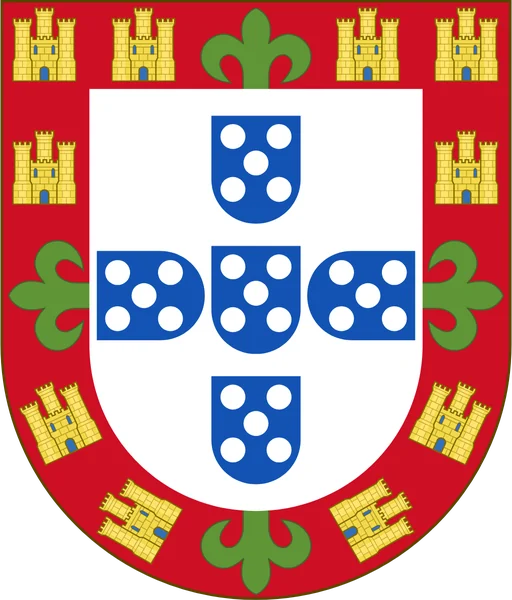
1385
Argent, five escutcheons in cross azure, each charged with five plates in saltire; a bordure gules charged with castles Or and with the four flowered ends vert of the cross of Avis.
D. João I, Master of Avis, joined the emblem of his order, a green flowered cross, to the royal arms. It was done in three ways: with the cross behind the shield, the form considered most correct; with its four ends in the bordure, between the castles, the most used; or with the ends over the field and the bordure, the rarest.
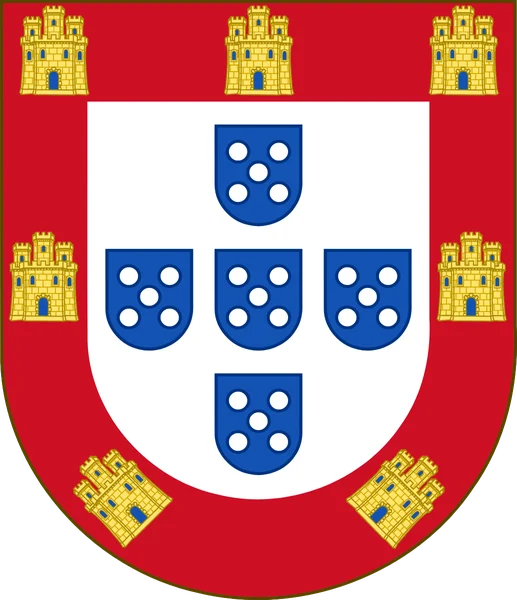
1485
Argent, five escutcheons in cross azure, each charged with five plates in saltire; a bordure gules charged with seven castles Or.
In 1485 D. João II gave the shield the marshalling it still has: upright flanking quinas, without the cross of Avis. Only the castles remained to be fixed, seven or eight through the 16th century depending on the shape of the shield; by the end of that century there were seven. Outside the shield, the royal crown, present in almost every depiction from D. Manuel I onwards, came with angels as supporters and a golden wyvern as crest, probably linked to Saint George, patron saint of Portugal.
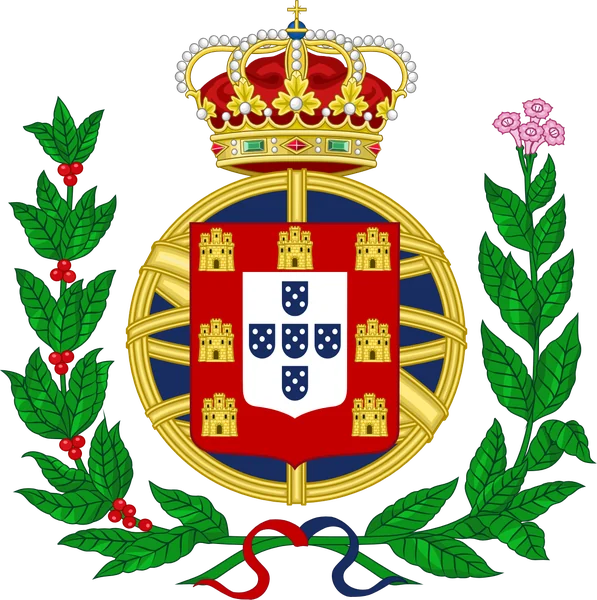
1816
The shield of Portugal set upon an armillary sphere Or on a field azure, ensigned with the royal crown.
The armillary sphere was the personal emblem of D. Manuel I, granted by D. João II in 1484 when he made him Duke of Beja, with the motto Spera in Deo e fac bonitatem. It then became an emblem of the overseas empire, common on the coins struck in Brazil. With the United Kingdom it became part of the national arms for the first time, as the arms of Brazil. Heralds still debate whether the sphere stood in a round blue shield or was an external ornament. It was removed in 1826.
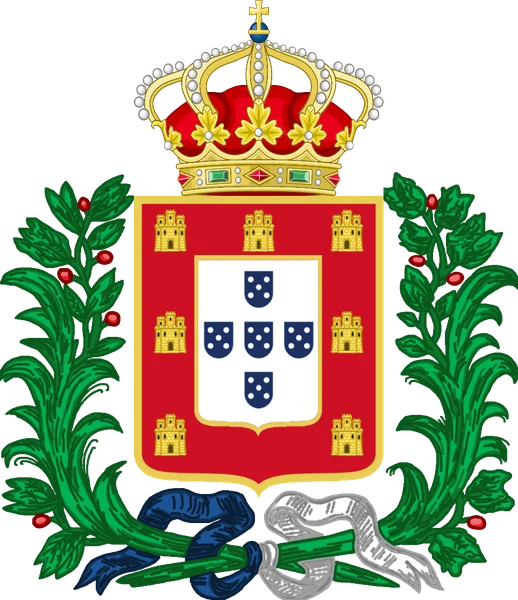
1834
The shield of Portugal ensigned with the royal crown, between two branches of laurel.
From the 16th century until 1910 the royal crown appeared in practically every depiction of the arms, and from D. Pedro II onwards it had four arches. Under the constitutional monarchy this version with laurel branches was the one in everyday use, on coins and official documents; the king’s personal arms were set apart by a purple mantle lined with ermine. These are the crowned arms that the Republic replaced in 1910.
1910
Argent, five escutcheons in cross azure, each charged with five plates in saltire, within a bordure gules charged with seven castles Or; the shield set upon an armillary sphere Or, between two branches of laurel of the same, tied with a ribbon.
The Republic kept the traditional shield, removed the crown and set the shield on an armillary sphere, now clearly an external ornament, standing no longer for Brazil but, in the words of the commission’s report, for the “adventurous genius” and maritime expansion of the Portuguese. The sphere of 1910 shows a single central meridian, not five as in 1816. They are described in detail below.
Arms of Portugal — the 1910 model, confirmed in 1911.
Argent, five escutcheons in cross azure, each charged with five plates in saltire, within a bordure gules charged with seven castles Or; the shield set upon an armillary sphere Or, between two branches of laurel of the same, tied with a ribbon.
On the flag, gold and silver are described as yellow and white, and the shield has a white edging that is not part of its heraldic marshalling. The sphere drawn by Columbano, in perspective, has six arcs: the ecliptic, the equator and two meridians, which are great circles, and the two tropics.
Three versions of the arms were defined in 1911. The simplest, just the shield on the sphere, is the one on the national flag and the naval jack. The second adds the laurel branches and a white ribbon bearing the line from Camões “Esta é a ditosa Pátria minha amada”, this is my beloved happy homeland, for the colours of military units. The third, with the ribbon left blank and usually painted green and red, was for seals, coins and official emblems.
They are the only element with no specifically national meaning: they recall the Roman laurel wreaths, a sign of victory and glory, and the 1910 report calls them simply a “triumphal symbol”. In some depictions they are green instead of gold, or one is replaced by an oak branch.
Because these were the colours of the republicans, already raised in the revolt of 31 January 1891 and on 5 October 1910. The 1910 commission’s report gave them no national meaning; today’s usual reading, green for hope and red for the blood of those who died for Portugal, arose under the Estado Novo.
Nobody knows for certain. The oldest explanation, from 1344, links them to the battle of Ourique: the five defeated Moorish kings, set in a cross, and the coins of Judas in the bezants. Camões sees in them the five wounds of Christ. A theory accepted among heralds speaks of a cross of blue leather nailed to the shield of D. Afonso Henriques, of which five pieces would have remained.
Tradition says they stand for the Algarve, conquered by D. Afonso III in 1249. The explanation most accepted today is that they come from the arms of his mother, D. Urraca de Castela, as a mark of difference the young prince added to the royal arms. The number was only fixed at seven at the end of the 16th century.
An astronomical instrument that D. João II gave as an emblem to the future D. Manuel I in 1484. It became a symbol of the overseas empire, appeared in the arms of the United Kingdom with Brazil from 1816 to 1826 and returned with the Republic, as an image of maritime expansion.
Because the Republic removed it in 1910. From the 16th century the royal crown had appeared in almost every depiction of the arms; the Republic kept the shield and replaced the crown with the armillary sphere.
It was presented to the country on 1 December 1910 and confirmed by the decree of the National Constituent Assembly of 19 June 1911. The design is by Columbano Bordalo Pinheiro.
The blue and white flag with the crowned royal arms in the centre, adopted in 1830. Blue and white were the colours of the quinas, approved as national colours in 1821. Before that the flag had a white field with the royal arms, and in the Middle Ages it reproduced the shield itself.
Illustrations: Wikimedia Commons. Medieval flags © Nuno Tavares and Giro720; flags of 1707, 1816, 1826 and 1830 © 117-M-I-K-E, with elements by Sodacan; shields of 1185, 1248 and 1385 © Bragancinho; shield of 1485 and arms of 1816 and 1834 © Wikimedia Commons contributors (CC BY-SA 4.0). Flags of 1578 and 1667, current flag and arms: public domain.
Last reviewed by the Emblema Mundi editorial team on 3 October 2026.