Country
Finland had no flag of its own until independence, but its lion is far older: crowned and golden, a sword in an armoured arm and a sabre underfoot, it first appears on the tomb of Gustav Vasa in Uppsala in the 1580s. The lion flag served the new state for a few months in 1918, before Parliament chose the blue cross on white that yacht clubs had flown since 1861.
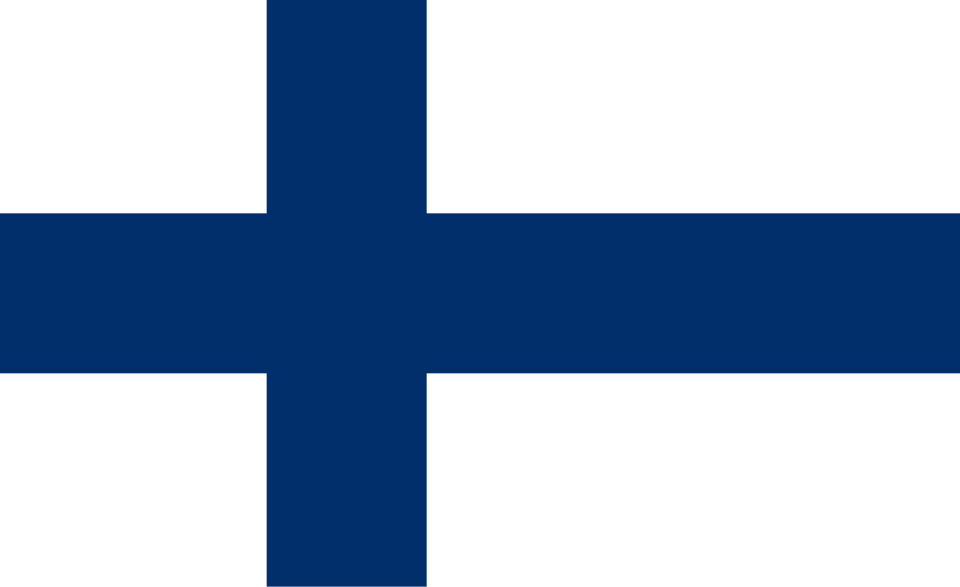
Flag
Not available
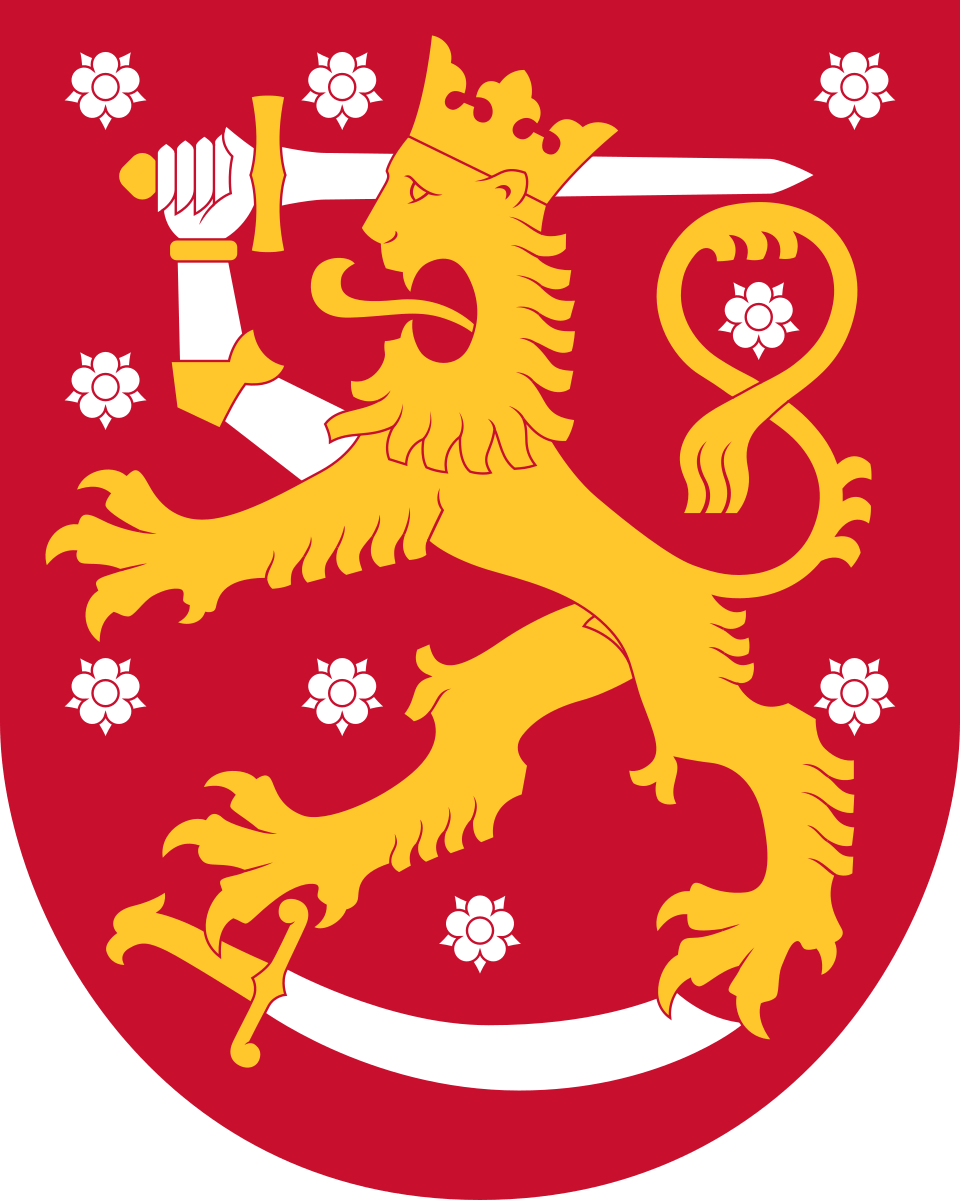
Coat of Arms
Not available
| Flag | A blue Nordic cross on white, 11 by 18 |
|---|---|
| Arms | Gules, a crowned lion Or with a sword in an armoured arm, trampling a sabre; nine roses Argent |
| Flag adopted | 28 May 1918, confirmed on 29 May |
| Arms in law | Act on the Coat of Arms of Finland, 1978 |
| Designers | Eero Snellman (flag sketches), Olof Eriksson (arms) |
Finland received an official flag only with independence, and had two in 1918 alone: first the red and yellow lion flag, then the blue cross on white that is still flown today.
Click the thumbnails to browse the flags.
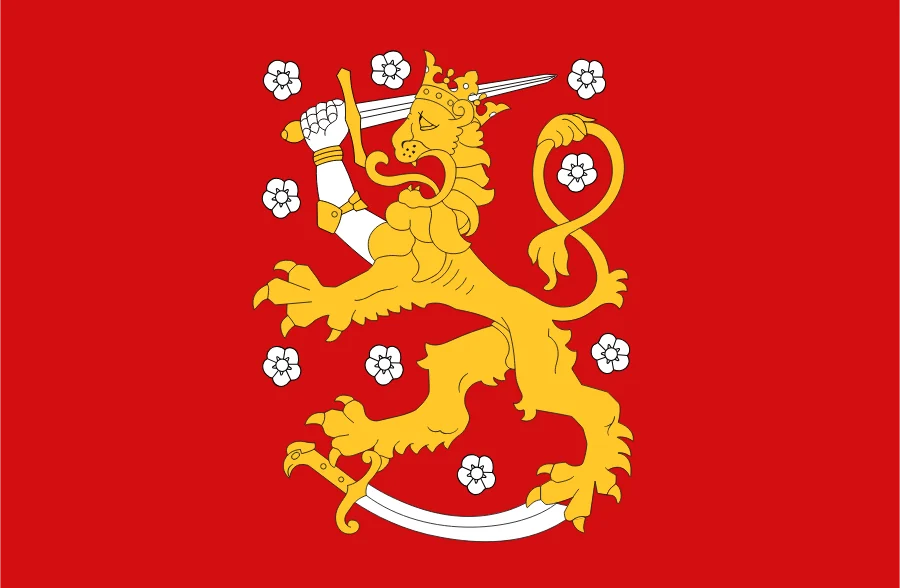
1918
Under Russian rule Finland had no flag of its own: its ships sailed under the Russian merchant flag, and an imperial proclamation of 1896 made the Russian flag the only one allowed. Finns flew the lion of their arms instead, on unofficial flags such as the one hailed as the flag of Finland at the students’ Flora Day of 1848; after 1896 the lion flag became a flag of resistance.
At independence, the flag committee set up by the Senate on 4 December 1917 proposed in four days a red and yellow flag of the arms, the leijonalippu: the lion and roses of the arms spread over the whole cloth. Red and yellow had long been defended as Finland’s colours because they were those of the arms. The lion flag served as the state flag in the first months of 1918.
1918
A blue cross on white, the arms of the cross reaching the edges and the upright shifted towards the hoist, in the Nordic pattern; the proportions are 11 by 18. The colours had been argued for since Zachris Topelius, who wrote in 1854: “white for the snow of our winters and blue for our blue lakes”. The design itself had flown since 1861 on the flags of the yacht clubs, which differed from today’s flag only in their proportions.
After the civil war, the victorious Whites would not accept red, the colour of the Red Guards, and Parliament voted for blue and white. Akseli Gallen-Kallela’s white cross on blue was rejected as too close to the flags of Sweden and Iceland; the painter Eero Snellman, helped by Bruno Tuukkanen, drew the final sketches in haste. The law was passed on 28 May 1918 and confirmed by the Senate the next day. The state flag bears the arms at the crossing of the cross; the plain flag, first the merchant flag, has been the national flag since 1978.
The lion has been the emblem of Finland since the 1580s, under Swedish kings, Russian emperors and the Republic. Each change of master shows in the details: the crown, and the sabre the lion tramples or holds. These are its stages, one for each period.
Click the thumbnails to browse the shields.
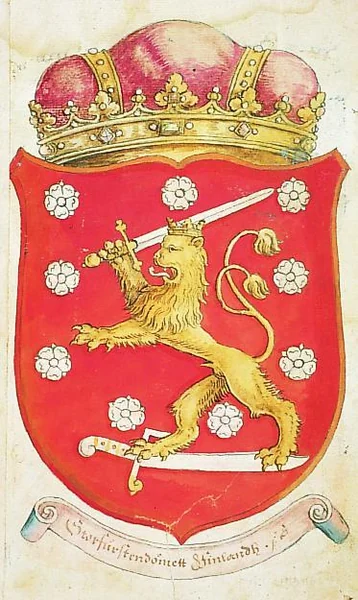
1580
A golden lion crowned, its right forepaw armed with a sword, trampling with both hind paws a Russian sabre.
So the arms were described in the 1580s. They first appear on the tomb monument of Gustav Vasa in Uppsala Cathedral, carved in the 1580s by the Fleming Willem Boy, among the arms of the provinces of the Swedish crown; they reflect the outlook of King Johan III, who added “Grand Duke of Finland” to his titles at the same time. The red stood for warlike spirit. The straight sword is thought to recall the German cavalry sword, the curved sabre the Turkish-Tatar type of the cavalry of Ivan the Terrible. The historian Matti Klinge reads the sabre as the Mongols or the Turks rather than Russia, whose soldiers never used such a weapon.
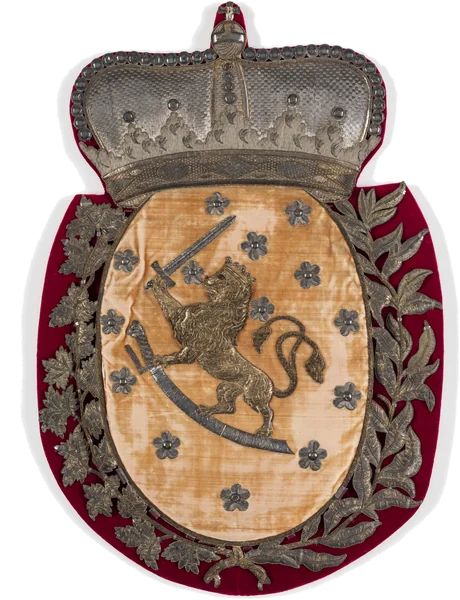
1809
A crowned lion standing on a silver sabre, which it holds with its left forepaw.
Once Russia had conquered Finland, the lion could no longer trample a sabre that pointed at Russia. In October 1809 Alexander I confirmed arms in which the lion stands on the sabre and holds it, the sabre now set at a slant so that it could hardly be trampled; the Swedish crown gave way to the crown of the Russian Empire. In the version of 1857 the lion no longer stands on the weapon at all but leans on it. The image shows the arms embroidered on the canopy of the emperor’s throne at the Diet of Porvoo in 1809.
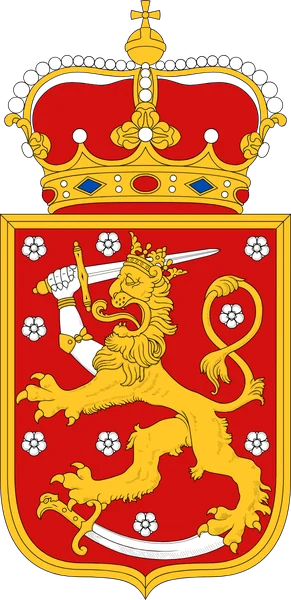
1918
Gules, a crowned lion Or holding a sword in an armoured arm and trampling a sabre, the field strewn with roses Argent; the shield ensigned with the grand-ducal crown.
The lion became the emblem of independent Finland in 1917. The artist Eric O. W. Ehrström went back to the arms on Gustav Vasa’s tomb and set the grand-ducal crown above the shield; Finnish Wikipedia calls them the arms of the Kingdom of Finland, the monarchy planned in 1918. The Council of State had the crown removed in 1920. Not everyone loved the beast: the socialist Otto Wille Kuusinen mocked the bourgeois in Parliament for finding in the Finnish forests a creature that does not live there.
1978
Gules, a crowned lion holding in an armoured hand, in place of the right forepaw, a sword raised to strike, and trampling a sabre with its hind paws; the lion with its crown and claws, the hilts of the weapons and the joints of the armour Or, the blades and the armour Argent; the field strewn with nine roses Argent.
The current drawing is by the herald Olof Eriksson, who also went back to the arms on Gustav Vasa’s tomb; the Act on the Coat of Arms of Finland of 1978 sets out the blazon. Proposals to change the lion came and went: Akseli Gallen-Kallela suggested a quartered shield of black and red in 1929, and the consul general Rudolf Ray a native bear breaking a yoke. Neither was adopted.
Coat of arms of Finland — as set out in the Act of 1978.
Gules, a crowned lion holding in an armoured hand, in place of the right forepaw, a sword raised to strike, and trampling a sabre with its hind paws; the lion with its crown and claws, the hilts of the weapons and the joints of the armour Or, the blades and the armour Argent; the field strewn with nine roses Argent.
The blazon is that of the Act on the Coat of Arms of Finland (381/1978). Selling as the arms of Finland a version that departs from it can be fined. Under the Grand Duchy the shield had a French outline; today it has a rounded, Spanish one.
The silver roses depict nothing: they were added simply as elements of the composition. They are sometimes thought to stand for the nine historical provinces of Finland, but their number has varied over the years; an 1881 version shows sixteen.
On vehicles the lion must be shown on the right-hand side looking to the right, so that it always faces the direction of travel and never seems to be backing away. The arms also appear on both state flags and on the flag of the President of the Republic.
Zachris Topelius gave the classic reading in 1854: white for the snow of the winters and blue for the lakes. A blue cross on white had flown on yacht club flags since 1861, and in 1918 Parliament chose blue and white because the victorious Whites rejected red, the colour of the Red Guards.
The red and yellow flag of the arms, with the golden lion and the roses on red. Long flown unofficially under Russian rule, it served as the state flag of independent Finland in the first months of 1918, until the blue cross was adopted in May.
The arms date from the 1580s, when Sweden and Russia were fighting over Karelia. They are often read as the straight sword of the West against the curved sabre of the East. The historian Matti Klinge sees the sabre as the Mongols or the Turks rather than Russia.
Nothing in particular: they were added as elements of the composition. Some see in them the nine historical provinces of Finland, but their number has varied over the centuries.
The arms drawn by Eric O. W. Ehrström at independence bore the grand-ducal crown above the shield, in the time of the planned Kingdom of Finland of 1918. The Council of State had it removed in 1920.
The final sketches were drawn in 1918 by the painter Eero Snellman, with Bruno Tuukkanen. Akseli Gallen-Kallela had proposed a white cross on blue, rejected because it was too close to the flags of Sweden and Iceland.
The national flag is the plain blue cross on white. The state flag, flown by Parliament, ministries and other state bodies, bears the coat of arms in a square at the crossing of the cross; a version with three tails was called the war flag until 1978.
Illustrations: Wikimedia Commons. Lion flag of 1918 © Tornisteri; arms of 1809 © National Museum of Finland (CC BY-SA 4.0). Arms of 1580 and 1918, current flag and arms: public domain.
Last reviewed by the Emblema Mundi editorial team on 3 October 2026.